
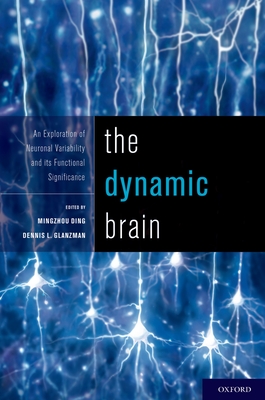
The Dynamic Brain : An Exploration of Neuronal Variability and its Functional Significance
Book Details
Format
Hardback
ISBN-10
0195393791
ISBN-13
9780195393798
Publisher
Oxford University Press Inc
Imprint
Oxford University Press Inc
Country of Manufacture
US
Country of Publication
GB
Publication Date
Feb 3rd, 2011
Print length
392 Pages
Weight
916 grams
Dimensions
23.60 x 16.00 x 2.50 cms
Product Classification:
Neurology & clinical neurophysiologyNeurology and clinical neurophysiologyNeurosciences
KSh 28,800.00
Currently unavailable
0 in stock
Delivery Location
Delivery fee: Select location
Secure
Quality
Fast
To understand how neurons work to bring about coherent behavior and its breakdown in disease, neuroscientists must take into account both known and unknown sources of variability, and evaluate network activities by computing interdependence measures among neurons and among different brain areas. This book examines neuronal variability from theoretical, experimental and clinical perspectives.
It is a well-known fact of neurophysiology that neuronal responses to identically presented stimuli are extremely variable. This variability has in the past often been regarded as "noise." At the single neuron level, interspike interval (ISI) histograms constructed during either spontaneous or stimulus evoked activity reveal a Poisson type distribution. These observations have been taken as evidence that neurons are intrinsically "noisy" in their firing properties. In fact, the use of averaging techniques, like post-stimulus time histograms (PSTH) or event-related potentials (ERPs) have largely been justified based on the presence of what was believed to be noise in the neuronal responses.More recent attempts to measure the information content of single neuron spike trains have revealed that a surprising amount of information can be coded in spike trains even in the presence of trial-to-trial variability. Multiple single unit recording experiments have suggested that variability formerly attributed to noise in single cell recordings may instead simply reflect system-wide changes in cellular response properties. These observations raise the possibility that, at least at the level of neuronal coding, the variability seen in single neuron responses may not simply reflect an underlying noisy process. They further raise the very distinct possibility that noise may in fact contain real, meaningful information which is available for the nervous system in information processing.To understand how neurons work in concert to bring about coherent behavior and its breakdown in disease, neuroscientists now routinely record simultaneously from hundreds of different neurons and from different brain areas, and then attempt to evaluate the network activities by computing various interdependence measures, including cross correlation, phase synchronization and spectral coherence. This book examines neuronal variability from theoretical, experimental and clinical perspectives.
Get The Dynamic Brain by Dennis Glanzman at the best price and quality guaranteed only at Werezi Africa's largest book ecommerce store. The book was published by Oxford University Press Inc and it has 392 pages.
Customers Who Bought This Also Bought

Awakenings
KSh 2,000.00

Deep History of Ourselves
KSh 3,250.00

On the Move
KSh 2,350.00

Brainstorm
KSh 2,000.00

Anthropologist on Mars
KSh 2,000.00

Age of Diagnosis
KSh 3,950.00

Migraine
KSh 2,000.00

Reclaiming Your Life After Rape: Client Workbook
KSh 9,900.00

Advances and Technical Standards in Neurosurgery, Vol. 33
KSh 16,200.00

Rebuilding Your Life after Stroke
KSh 4,700.00

Chemical Signatures of the Brain
KSh 35,800.00

Cecile and Oskar Vogt
KSh 8,100.00
