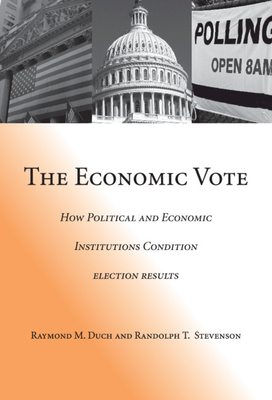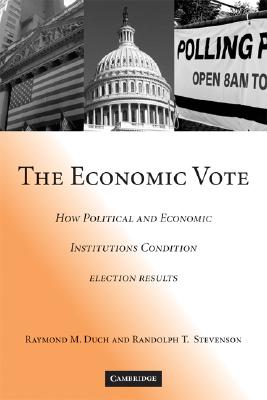
The Economic Vote : How Political and Economic Institutions Condition Election Results
Book Details
Format
Paperback / softback
Book Series
Political Economy of Institutions and Decisions
ISBN-10
0521707404
ISBN-13
9780521707404
Publisher
Cambridge University Press
Imprint
Cambridge University Press
Country of Manufacture
GB
Country of Publication
GB
Publication Date
Mar 17th, 2008
Print length
418 Pages
Weight
570 grams
Dimensions
23.00 x 15.50 x 2.40 cms
Product Classification:
Politics & governmentPolitics and government
KSh 6,500.00
Currently unavailable
0 in stock
Delivery Location
Delivery fee: Select location
Secure
Quality
Fast
The book explains how different political and economic circumstances account for the variation in the economic vote. Based on the analysis of 165 public opinion surveys from 19 countries, the authors demonstrate that their explanations are empirically sound.
This book proposes a selection model for explaining cross-national variation in economic voting: Rational voters condition the economic vote on whether incumbents are responsible for economic outcomes, because this is the optimal way to identify and elect competent economic managers under conditions of uncertainty. This model explores how political and economic institutions alter the quality of the signal that the previous economy provides about the competence of candidates. The rational economic voter is also attentive to strategic cues regarding the responsibility of parties for economic outcomes and their electoral competitiveness. Theoretical propositions are derived, linking variation in economic and political institutions to variability in economic voting. The authors demonstrate that there is economic voting, and that it varies significantly across political contexts. The data consist of 165 election studies conducted in 19 different countries over a 20-year time period.
Get The Economic Vote by Randolph T. Stevenson, Raymond M. Duch at the best price and quality guaranteed only at Werezi Africa's largest book ecommerce store. The book was published by Cambridge University Press and it has 418 pages.
Customers Who Bought This Also Bought
Regime Change
KSh 5,050.00

Art of War / The Book of Lord Shang
KSh 1,100.00

Wretched of the Earth
KSh 2,000.00

White Saviorism In International Development
KSh 3,800.00
How To Do Nothing
KSh 2,700.00

How Civil Wars Start
KSh 2,000.00

Tomorrow Is Yesterday
KSh 4,700.00

The Thinking Machine
KSh 2,350.00

Second Treatise of Government – Norton Library
KSh 1,600.00

Becoming
KSh 2,350.00

A River in Darkness
KSh 1,250.00
Warning to the West
KSh 1,600.00