
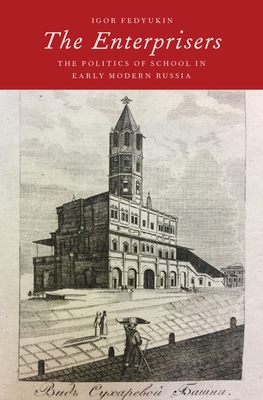
The Enterprisers : The Politics of School in Early Modern Russia
Book Details
Format
Hardback
ISBN-10
0190845007
ISBN-13
9780190845001
Publisher
Oxford University Press Inc
Imprint
Oxford University Press Inc
Country of Manufacture
US
Country of Publication
GB
Publication Date
Jun 13th, 2019
Print length
328 Pages
Weight
612 grams
Dimensions
15.50 x 23.60 x 3.10 cms
Product Classification:
European historyArchaeologyHistory of education
KSh 13,700.00
Currently unavailable
0 in stock
Delivery Location
Delivery fee: Select location
Secure
Quality
Fast
Fedyukin draws on a wealth of unpublished archival sources to demonstrate that the evolution of "modern" schools in Russia under Peter I and his successors was driven not by the omnipresent monarch or the impersonal state, but rather by the efforts of "administrative entrepreneurs" seeking to advance their own agendas.
The Enterprisers traces the emergence of the "modern" school in Russia during the reigns of Peter I and his immediate successors, up to the accession of Catherine II. Creation of the new, secular, technically-oriented schools based on the imported Western European blueprints is traditionally presented as the key element in Peter I''s transformation of Russia.The tsar, it is assumed, needed schools to train officers and engineers for his new army and the navy, and so he personally designed these new institutions and forced them upon his unwilling subjects. In this sense, school also stands in as a metaphor for modern institutions in Russia in general, which are likewise seen as created from the top down, by the forceful state, in response to its military and technological needs.Yet, in reality, Peter I himself never wrote much about education, and while he championed "learning" in a broad sense, he had remarkably little to say about the ways schools and schooling should be organized. Nor were his general and admirals, including foreigners in Russian service, keen on promoting formal schooling: for them, practical apprenticeship still remained the preferred method of training. Rather, as Fedyukin argues in this book, the trajectories of institutional change were determined by the efforts of "administrative entrepreneurs"-or projecteurs, as they were also called-who built new schools as they sought to achieve diverse career goals, promoted their own pet ideas, advanced their claims for expertise, and competed for status and resources. By drawing on a wealth of unpublished archival sources, Fedyukin explores the "micropolitics" behind the key episodes of educational innovation in the first half of the eighteenth century and offers an entirely new way of thinking about "Petrine revolution" and about the early modern state in Russia.
Get The Enterprisers by Igor Fedyukin at the best price and quality guaranteed only at Werezi Africa's largest book ecommerce store. The book was published by Oxford University Press Inc and it has 328 pages.
Customers Who Bought This Also Bought

Age of Revolutions
KSh 2,350.00

Eichmann in Jerusalem
KSh 2,350.00

Trouble With Being Born
KSh 2,000.00

Hiroshima
KSh 2,000.00
Freedom
KSh 6,300.00

Holocaust
KSh 2,700.00
The History of the Peloponnesian War
KSh 2,700.00
Annals
KSh 2,350.00
Greek Lives
KSh 2,150.00

Sleepwalkers
KSh 3,400.00

Napoleon The Great
KSh 3,600.00
Diary of a Young Girl
KSh 1,800.00
