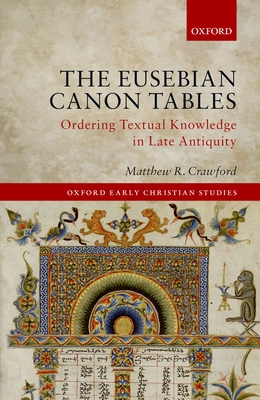
The Eusebian Canon Tables : Ordering Textual Knowledge in Late Antiquity
Book Details
Format
Hardback
Book Series
Oxford Early Christian Studies
ISBN-10
0198802609
ISBN-13
9780198802600
Publisher
Oxford University Press
Imprint
Oxford University Press
Country of Manufacture
GB
Country of Publication
GB
Publication Date
May 6th, 2019
Print length
394 Pages
Weight
808 grams
Dimensions
16.80 x 24.10 x 2.40 cms
Product Classification:
The Early ChurchNew Testaments
KSh 22,950.00
Currently unavailable
0 in stock
Delivery Location
Delivery fee: Select location
Secure
Quality
Fast
This study investigates the origins and use of the Canon Tables apparatus, which was included in the four-gospel codex. This reading aid was invented in the early fourth century by Eusebius of Caesarea and represented a milestone achievement both in the history of the book and in the scholarly study of the fourfold gospel.
One of the books most central to late-antique religious life was the four-gospel codex, containing the Gospels of Matthew, Mark, Luke, and John. A common feature in such manuscripts was a marginal cross-referencing system known as the Canon Tables. This reading aid was invented in the early fourth century by Eusebius of Caesarea and represented a milestone achievement both in the history of the book and in the scholarly study of the fourfold gospel. In this work, Matthew R. Crawford provides the first book-length treatment of the origins and use of the Canon Tables apparatus in any language. Part one begins by defining the Canon Tables as a paratextual device that orders the textual content of the fourfold gospel. It then considers the relation of the system to the prior work of Ammonius of Alexandria and the hermeneutical implications of reading a four-gospel codex equipped with the marginal apparatus. Part two transitions to the reception of the paratext in subsequent centuries by highlighting four case studies from different cultural and theological traditions, from Augustine of Hippo, who used the Canon Tables to develop the first ever theory of gospel composition, to a Syriac translator in the fifth century, to later monastic scholars in Ireland between the seventh and ninth centuries. Finally, from the eighth century onwards, Armenian commentators used the artistic adornment of the Canon Tables as a basis for contemplative meditation. These four case studies represent four different modes of using the Canon Tables as a paratext and illustrate the potential inherent in the Eusebian apparatus for engaging with the fourfold gospel in a variety of ways, from the philological to the theological to the visual.
Get The Eusebian Canon Tables by Matthew R. Crawford at the best price and quality guaranteed only at Werezi Africa's largest book ecommerce store. The book was published by Oxford University Press and it has 394 pages.
Customers Who Bought This Also Bought
Augustine the African
KSh 4,500.00
Paul: A Critical Life
KSh 7,400.00

St Paul
KSh 2,000.00

Paul
KSh 4,700.00

Martyrdom and Persecution in the Early Church
KSh 9,500.00

Patrology
KSh 12,250.00
The Slow Fall of Babel
KSh 17,800.00

Exegesis and Theology in Early Christianity
KSh 33,000.00
Resurrection and Reception in Early Christianity
KSh 10,100.00

Gregory The Great
KSh 30,950.00

Die Begruendung der Erkenntnis nach Bernhard von Clairvaux
KSh 11,700.00

How Christians Can Succeed Today
KSh 3,050.00