
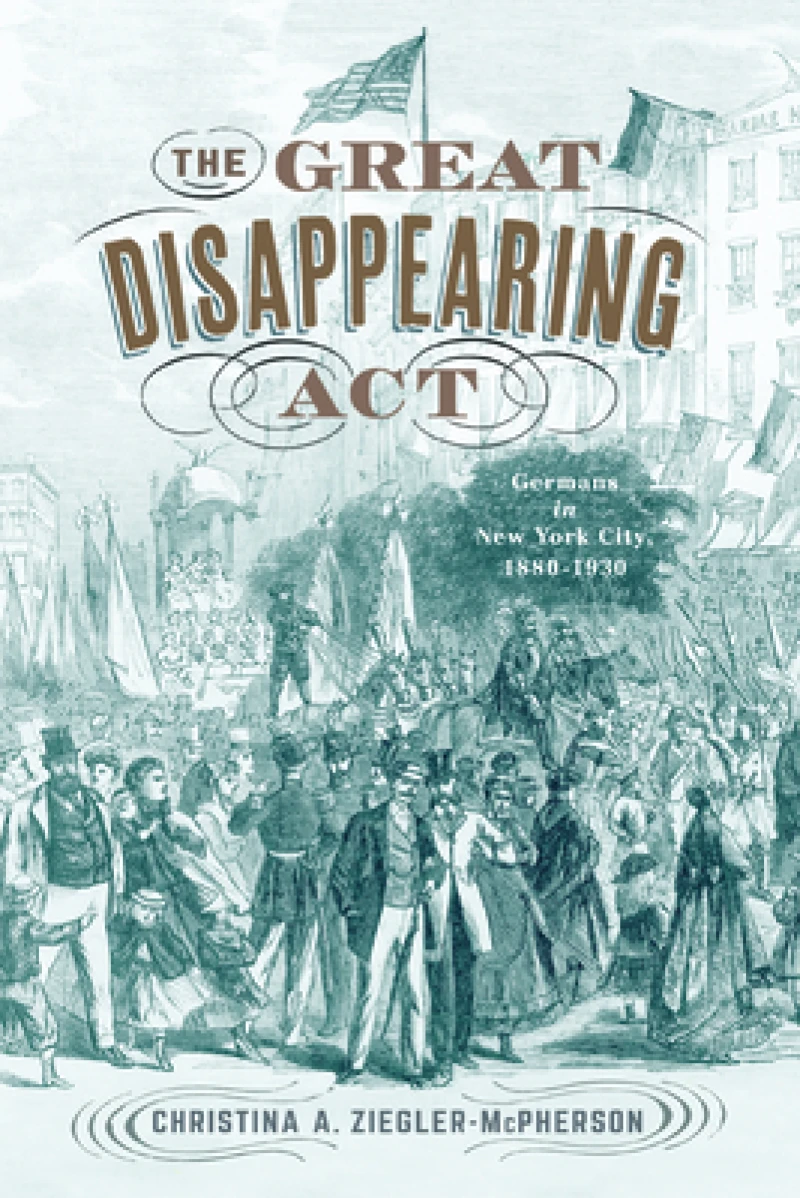
The Great Disappearing Act : Germans in New York City, 1880-1930
Book Details
Format
Paperback / Softback
ISBN-10
1978823185
ISBN-13
9781978823181
Publisher
Rutgers University Press
Imprint
Rutgers University Press
Country of Manufacture
GB
Country of Publication
GB
Publication Date
Dec 10th, 2021
Print length
238 Pages
Weight
340 grams
Dimensions
22.90 x 15.20 x 1.80 cms
Product Classification:
United States of America, USAUS Northeast: Mid-Atlantic States19th century, c 1800 to c 189920th century, c 1900 to c 1999History of the AmericasModern history to 20th century: c 1700 to c 190020th century history: c 1900 to c 2000Social & cultural historyHistoryHistory of the AmericasSocial and cultural historyLocal history
Ksh 4,500.00
Werezi Extended Catalogue
0 in stock
Delivery Location
Delivery fee: Select location
Secure
Quality
Fast
How does a community of several hundred thousand people become invisible within a generation? This study examines this question in relation to the German immigrant community in New York City between 1880 and 1930, and seeks to understand how German-American New Yorkers assimilated into the larger American society in the early twentieth century.
Where did all the Germans go? How does a community of several hundred thousand people become invisible within a generation?
This study examines these questions in relation to the German immigrant community in New York City between 1880-1930, and seeks to understand how German-American New Yorkers assimilated into the larger American society in the early twentieth century.
By the turn of the twentieth century, New York City was one of the largest German-speaking cities in the world and was home to the largest German community in the United States. This community was socio-economically diverse and increasingly geographically dispersed, as upwardly mobile second and third generation German Americans began moving out of the Lower East Side, the location of America''s first Kleindeutschland (Little Germany), uptown to Yorkville and other neighborhoods. New York''s German American community was already in transition, geographically, socio-economically, and culturally, when the anti-German/One Hundred Percent Americanism of World War I erupted in 1917.
This book examines the structure of New York City''s German community in terms of its maturity, geographic dispersal from the Lower East Side to other neighborhoods, and its ultimate assimilation to the point of invisibility in the 1920s. It argues that when confronted with the anti-German feelings of World War I, German immigrants and German Americans hid their culture – especially their language and their institutions – behind closed doors and sought to make themselves invisible while still existing as a German community.
But becoming invisible did not mean being absorbed into an Anglo-American English-speaking culture and society. Instead, German Americans adopted visible behaviors of a new, more pluralistic American culture that they themselves had helped to create, although by no means dominated. Just as the meaning of "German" changed in this period, so did the meaning of "American" change as well, due to nearly 100 years of German immigration.
This study examines these questions in relation to the German immigrant community in New York City between 1880-1930, and seeks to understand how German-American New Yorkers assimilated into the larger American society in the early twentieth century.
By the turn of the twentieth century, New York City was one of the largest German-speaking cities in the world and was home to the largest German community in the United States. This community was socio-economically diverse and increasingly geographically dispersed, as upwardly mobile second and third generation German Americans began moving out of the Lower East Side, the location of America''s first Kleindeutschland (Little Germany), uptown to Yorkville and other neighborhoods. New York''s German American community was already in transition, geographically, socio-economically, and culturally, when the anti-German/One Hundred Percent Americanism of World War I erupted in 1917.
This book examines the structure of New York City''s German community in terms of its maturity, geographic dispersal from the Lower East Side to other neighborhoods, and its ultimate assimilation to the point of invisibility in the 1920s. It argues that when confronted with the anti-German feelings of World War I, German immigrants and German Americans hid their culture – especially their language and their institutions – behind closed doors and sought to make themselves invisible while still existing as a German community.
But becoming invisible did not mean being absorbed into an Anglo-American English-speaking culture and society. Instead, German Americans adopted visible behaviors of a new, more pluralistic American culture that they themselves had helped to create, although by no means dominated. Just as the meaning of "German" changed in this period, so did the meaning of "American" change as well, due to nearly 100 years of German immigration.
Get The Great Disappearing Act by at the best price and quality guaranteed only at Werezi Africa's largest book ecommerce store. The book was published by Rutgers University Press and it has pages.

