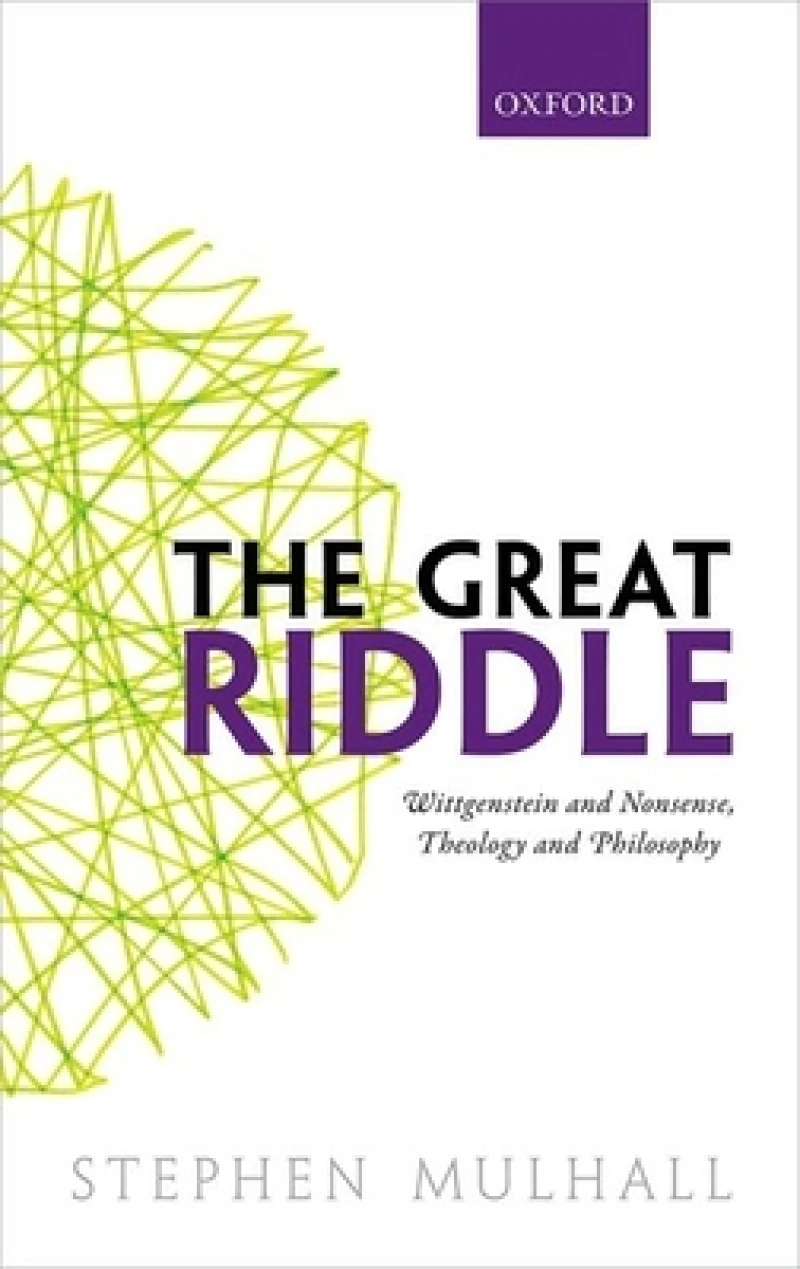
The Great Riddle : Wittgenstein and Nonsense, Theology and Philosophy
Book Details
Format
Hardback or Cased Book
ISBN-10
0198755325
ISBN-13
9780198755326
Publisher
Oxford University Press
Imprint
Oxford University Press
Country of Manufacture
GB
Country of Publication
GB
Publication Date
Dec 3rd, 2015
Print length
148 Pages
Weight
288 grams
Dimensions
22.70 x 16.40 x 2.20 cms
Ksh 11,550.00
Manufactured on Demand
0 in stock
Delivery Location
Delivery fee: Select location
Secure
Quality
Fast
Can we talk meaningfully about God? Grammatical Thomism affirms that religious language is nonsensical, because the reality of God is beyond our capacity for expression. 'Nonsense' is standardly taken to be a term of criticism in Wittgenstein's work, but Mulhall argues that we can exploit an analogy with riddles to take a more positive view.
Can we talk meaningfully about God? The theological movement known as Grammatical Thomism affirms that religious language is nonsensical, because the reality of God is beyond our capacity for expression. Stephen Mulhall critically evaluates the claims of this movement (as exemplified in the work of Herbert McCabe and David Burrell) to be a legitimate inheritor of Wittgenstein''s philosophical methods as well as Aquinas''s theological project. The major obstacle to this claim is that Grammatical Thomism makes the nonsensicality of religious language when applied to God a touchstone of Thomist insight, whereas ''nonsense'' is standardly taken to be solely a term of criticism in Wittgenstein''s work. Mulhall argues that, if Wittgenstein is read in the terms provided by the work of Cora Diamond and Stanley Cavell, then a place can be found in both his early work and his later writings for a more positive role to be assigned to nonsensical utterances--one which depends on exploiting an analogy between religious language and riddles. And once this alignment between Wittgenstein and Aquinas is established, it also allows us to see various ways in which his later work has a perfectionist dimension--in that it overlaps with the concerns of moral perfectionism, and in that it attributes great philosophical significance to what theology and philosophy have traditionally called ''perfections'' and ''transcendentals'', particularly concepts such as Being, Truth, and Unity or Oneness. This results in a radical reconception of the role of analogous usage in language, and so in the relation between philosophy and theology.
Get The Great Riddle by at the best price and quality guaranteed only at Werezi Africa's largest book ecommerce store. The book was published by Oxford University Press and it has pages.