
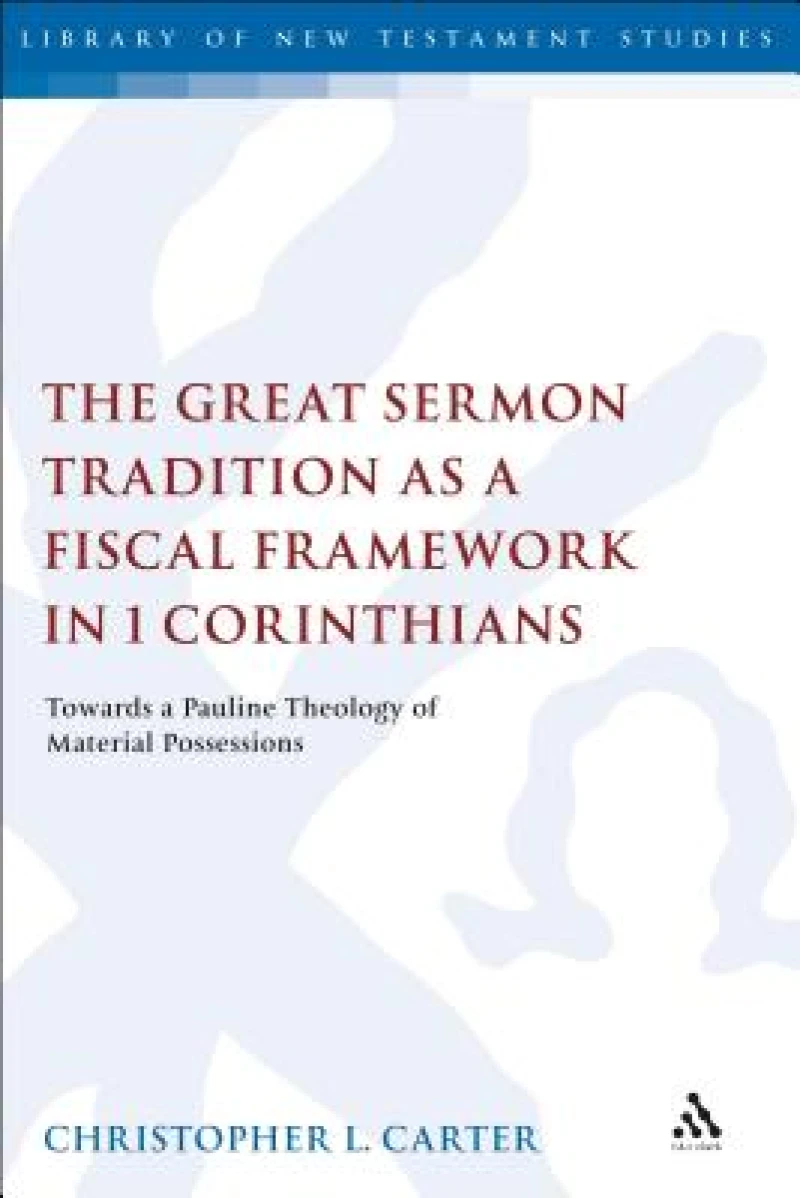
The Great Sermon Tradition as a Fiscal Framework in 1 Corinthians : Towards a Pauline Theology of Material Possessions
Book Details
Format
Paperback / Softback
Book Series
The Library of New Testament Studies
ISBN-10
0567689298
ISBN-13
9780567689290
Publisher
Bloomsbury Publishing PLC
Imprint
T.& T.Clark Ltd
Country of Manufacture
GB
Country of Publication
GB
Publication Date
Jun 27th, 2019
Print length
288 Pages
Weight
444 grams
Dimensions
20.50 x 26.00 x 1.50 cms
Product Classification:
New Testaments
Ksh 5,950.00
Manufactured on Demand
0 in stock
Delivery Location
Delivery fee: Select location
Secure
Quality
Fast
This text addresses two separate but related questions. Firstly, what is Paul's theology of material possessions, and secondly, what is the source of the apostle's thought on this subject? Carter endeavours to answer these questions by posing the hypothesis that Paul owes his pecuniary thought to the synoptic sermon tradition. Unlike other studies that investigate this link, Carter does not appeal to verbal parallels to establish this theory. Rather, he demonstrates a continuity in the broad fiscal thought of Jesus and Paul. This is accomplished by first demonstrating the plausibility of Paul's acquaintance with the dominical tradition through evidence related to the apostle's historical environment and his extant writings. The author then establishes the likelihood that Paul knew the pre-synoptic sermon tradition because of its ubiquity in early church discipleship, the judgment of form critical scholars, and its pervasive resonances in Pauline literature. From this point of embarkation, Carter moves on to articulate the broad fiscal thought of the synoptic sermons. It is found that the synoptic sermons' fiscal material has a pervasively eschatological orientation, and that in the sermons, Jesus seeks to redefine the financial worldview of Christian disciples. Having examined the synoptic sermons, their fiscal thought is compared with that expressed by Paul in 1 Corinthians. Through the course of this comparison, alternate sources in Jewish and Hellenistic literature are considered as potential explanations for any correspondences. Ultimately, the study concludes that Jesus' and Paul's financial thought evidence remarkable symmetry that cannot be explained by a shared cultural environment. Consequently, it is determined that Paul very likely depends on the dominical tradition for the contours of his financial thought.
This text addresses two separate but related questions. Firstly, what is Paul''s theology of material possessions, and secondly, what is the source of the apostle''s thought on this subject? Carter endeavours to answer these questions by posing the hypothesis that Paul owes his pecuniary thought to the synoptic sermon tradition. Unlike other studies that investigate this link, Carter does not appeal to verbal parallels to establish this theory. Rather, he demonstrates a continuity in the broad fiscal thought of Jesus and Paul. This is accomplished by first demonstrating the plausibility of Paul''s acquaintance with the dominical tradition through evidence related to the apostle''s historical environment and his extant writings.
The author then establishes the likelihood that Paul knew the pre-synoptic sermon tradition because of its ubiquity in early church discipleship, the judgment of form critical scholars, and its pervasive resonances in Pauline literature. From this point of embarkation, Carter moves on to articulate the broad fiscal thought of the synoptic sermons. It is found that the synoptic sermons'' fiscal material has a pervasively eschatological orientation, and that in the sermons, Jesus seeks to redefine the financial worldview of Christian disciples.
Having examined the synoptic sermons, their fiscal thought is compared with that expressed by Paul in 1 Corinthians. Through the course of this comparison, alternate sources in Jewish and Hellenistic literature are considered as potential explanations for any correspondences. Ultimately, the study concludes that Jesus'' and Paul''s financial thought evidence remarkable symmetry that cannot be explained by a shared cultural environment. Consequently, it is determined that Paul very likely depends on the dominical tradition for the contours of his financial thought.
Get The Great Sermon Tradition as a Fiscal Framework in 1 Corinthians by at the best price and quality guaranteed only at Werezi Africa's largest book ecommerce store. The book was published by Bloomsbury Publishing PLC and it has pages.

