
Cart 0
The Guide to Gethsemane
Click to zoom

Share this book

The Guide to Gethsemane : Anxiety, Suffering, Death

New

Book Details

Format Paperback / Softback
ISBN-10 0823281957
ISBN-13 9780823281954
Edition New
Publisher Fordham University Press
Imprint Fordham University Press
Country of Manufacture GB
Country of Publication GB
Publication Date Nov 6th, 2018
Print length 277 Pages
Weight 326 grams
Dimensions 15.50 x 22.90 x 1.20 cms
Ksh 5,400.00
Werezi Extended Catalogue Delivery in 28 days

Delivery Location

Delivery fee: Select location

Delivery in 28 days

Secure
Quality
Fast
Anxiety, suffering and death are not simply the "ills" of our society, nor are they uniquely the product of a sick and sinful humanity. We must all some day confront them, and we continually face their implications long before we do. In that sense, the Garden of Gethsemane is not merely a garden "outside the walls" of Jerusalem but also the essential horizon for all of us, whether we are believers or not. Emmanuel Falque explores, with no small measure of doubt, Heidegger's famous statement that by virtue of Christianity's claims of salvation and the afterlife, its believers cannot authentically experience anxiety in the face of death. In this theological development of the Passion, already widely debated upon its publication in French, Falque places a radical emphasis on the physicality and corporeality of Christ's suffering and death, marking the continuities between Christ's Passion and our own orientation to the mortality of our bodies. Beginning with an elaborate reading of the divine and human bodies whose suffering is masterfully depicted in the Isenheim Altarpiece, and written in the wake of the death of a close friend, Falques's study is both theologically rigorous and marked by deeply human concerns. Falque is at unusual pains to elaborate the question of death in terms not merely of faith, but of a "credible Christianity" that remains meaningful to non-Christians, holding, with Maurice Blondel, that "the important thing is not to address believers but to say something which counts in the eyes of unbelievers." His account is therefore as much a work of philosophy as of theology—and of philosophy explicated not through abstractions but through familiar and ordinary experience. Theology's task, for Falque, is to understand that human problems of the meaning of existence apply even to Christ, at least insofar as he lives in and shares our finitude. In Falque's remarkable account, Christ takes upon himself the burden of suffering finitude, so that he can undertake a passage through it, or a transformation of it. This book, a key text from one the most remarkable of a younger generation of philosophers and theologians, will be widely read and debated by all who hold that theology and philosophy has the most to offer when it eschews easy answers and takes seriously our most anguishing human experiences.

Anxiety, suffering and death are not simply the “ills” of our society, nor are they uniquely the product of a sick and sinful humanity. We must all some day confront them, and we continually face their implications long before we do. In that sense, the Garden of Gethsemane is not merely a garden “outside the walls” of Jerusalem but also the essential horizon for all of us, whether we are believers or not.

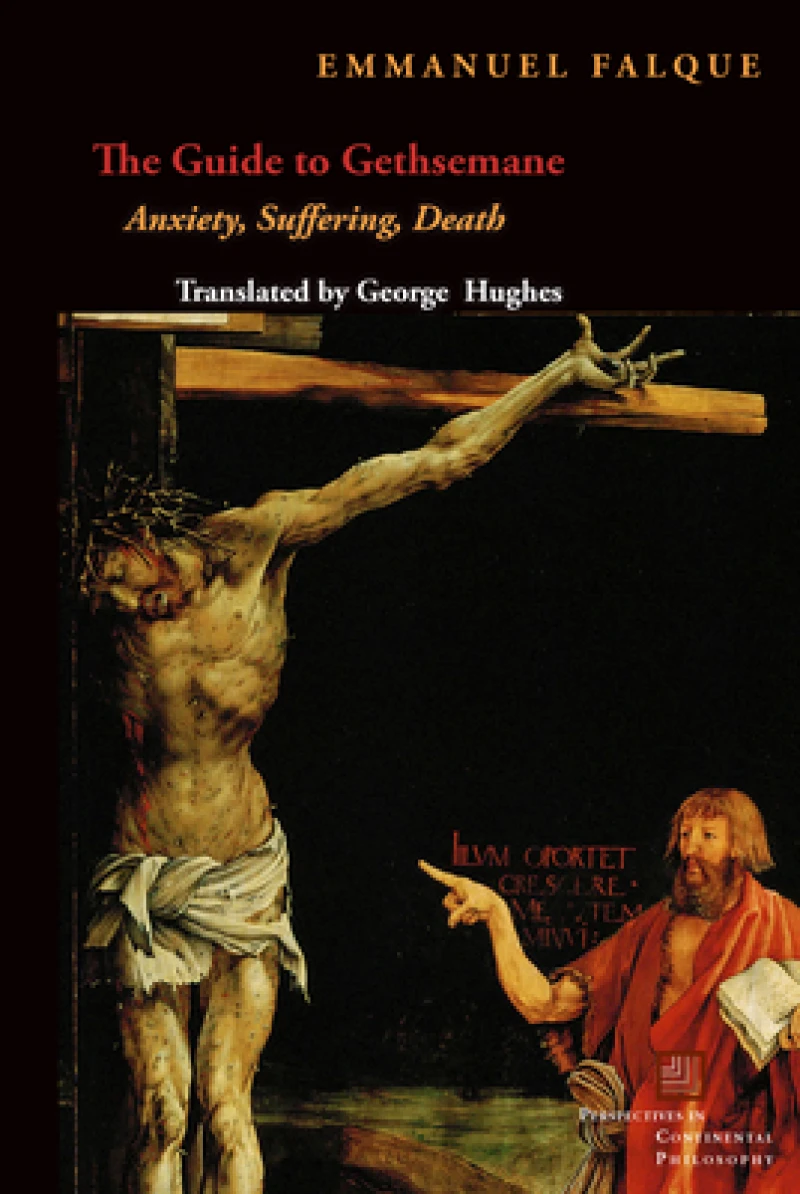
Emmanuel Falque explores, with no small measure of doubt, Heidegger’s famous statement that by virtue of Christianity’s claims of salvation and the afterlife, its believers cannot authentically experience anxiety in the face of death. In this theological development of the Passion, already widely debated upon its publication in French, Falque places a radical emphasis on the physicality and corporeality of Christ’s suffering and death, marking the continuities between Christ’s Passion and our own orientation to the mortality of our bodies. Beginning with an elaborate reading of the divine and human bodies whose suffering is masterfully depicted in the Isenheim Altarpiece, and written in the wake of the death of a close friend, Falques’s study is both theologically rigorous and marked by deeply human concerns.

Falque is at unusual pains to elaborate the question of death in terms not merely of faith, but of a “credible Christianity” that remains meaningful to non-Christians, holding, with Maurice Blondel, that “the important thing is not to address believers but to say something which counts in the eyes of unbelievers.” His account is therefore as much a work of philosophy as of theology—and of philosophy explicated not through abstractions but through familiar and ordinary experience. Theology’s task, for Falque, is to understand that human problems of the meaning of existence apply even to Christ, at least insofar as he lives in and shares our finitude. In Falque’s remarkable account, Christ takes upon himself the burden of suffering finitude, so that he can undertake a passage through it, or a transformation of it.

This book, a key text from one the most remarkable of a younger generation of philosophers and theologians, will be widely read and debated by all who hold that theology and philosophy has the most to offer when it eschews easy answers and takes seriously our most anguishing human experiences.


Get The Guide to Gethsemane by at the best price and quality guaranteed only at Werezi Africa's largest book ecommerce store. The book was published by Fordham University Press and it has pages.


Mind, Body, & Spirit

Price

Ksh 5,400.00

Shopping Cart

Africa largest book store

Sub Total:
Ebooks

Digital Library
Coming Soon

Our digital collection is currently being curated to ensure the best possible reading experience on Werezi. We'll be launching our Ebooks platform shortly.