
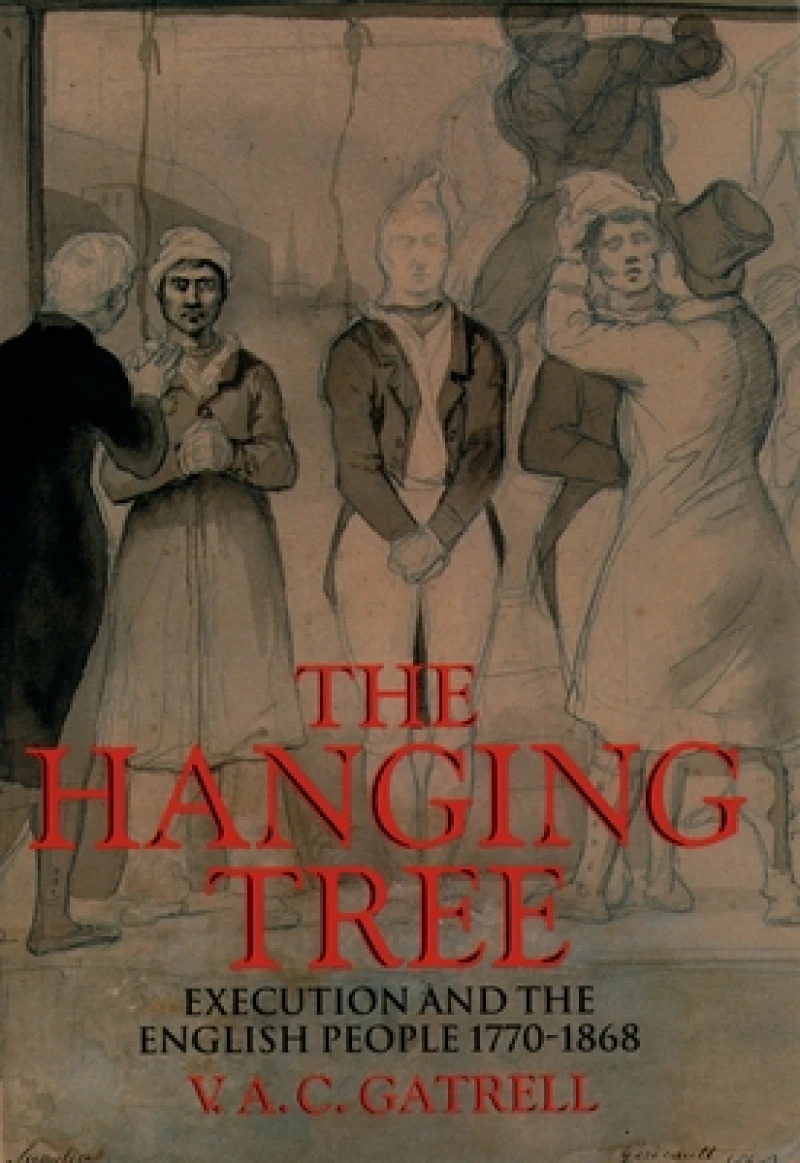
The Hanging Tree : Execution and the English People 1770-1868
by
Gatrell
Book Details
Format
Paperback / Softback
ISBN-10
0192853325
ISBN-13
9780192853325
Publisher
Oxford University Press
Imprint
Oxford University Press
Country of Manufacture
GB
Country of Publication
GB
Publication Date
Oct 17th, 1996
Print length
656 Pages
Weight
980 grams
Dimensions
22.90 x 15.70 x 3.70 cms
Ksh 18,850.00
Manufactured on Demand
0 in stock
Delivery Location
Delivery fee: Select location
Secure
Quality
Fast
Hanging people for small crimes as well as grave, the Bloody Penal Code was at its most active between 1770 and 1830. In those years some 7000 men and women were executed on public scaffolds, watched by thousands. This book explores what a wide range of people felt about these ceremonies.
Hanging people for small crimes as well as grave, the Bloody Penal Code was at its most active between 1770 and 1830. In those years some 7,000 men and women were executed on public scaffolds, watched by thousands. Hanging was confined to murderers thereafter, but these were still killed in public until 1868. Clearly the gallows loomed over much of social life in this period. But how did those who watched, read about, or ordered these strangulations feel about the terror and suffering inflicted in the law''s name? What kind of justice was delivered, and how did it change?This book is the first to explore what a wide range of people felt about these ceremonies (rather than what a few famous men thought and wrote about them). A history of mentalities, emotions, and attitudes rather than of policies and ideas, it analyses responses to the scaffold at all social levels: among the crowds which gathered to watch executions; among `polite'' commentators from Boswell and Byron on to Fry, Thackeray, and Dickens; and among the judges, home secretary, and monarch who decided who should hang and who should be reprieved. Drawing on letters, diaries, ballads, broadsides, and images, as well as on poignant appeals for mercy which historians until now have barely explored, the book surveys changing attitudes to death and suffering, `sensibility'' and `sympathy'', and demonstrates that the long retreat from public hanging owed less to the growth of a humane sensibility than it did to the development of new methods of punishment and law enforcement, and to polite classes'' deepening squeamishness and fear of the scaffold crowd.This gripping study is essential reading for anyone interested in the processes which have ''civilized'' our social life. Challenging many conventional understandings of the period, V. A. C. Gatrell sets new agendas for all students of eighteenth- and nineteenth-century culture and society, while reflecting uncompromisingly on the origins and limits of our modern attitudes to other people''s misfortunes. Panoramic in range, scholarly in method, and compelling in argument, this is one of those rare histories which both shift our sense of the past and speak powerfully to the present.
Hanging people for small crimes as well as grave, the Bloody Penal Code was at its most active between 1770 and 1830. In those years some 7,000 men and women were executed on public scaffolds, watched by thousands. Hanging was confined to murderers thereafter, but these were still killed in public until 1868. Clearly the gallows loomed over much of social life in this period. But how did those who watched, read about, or ordered these strangulations feel about the terror and suffering inflicted in the law''s name? What kind of justice was delivered, and how did it change? This book is the first to explore what a wide range of people felt about these ceremonies (rather than what a few famous men thought and wrote about them). A history of mentalities, emotions, and attitudes rather than of policies and ideas, it analyses responses to the scaffold at all social levels: among the crowds which gathered to watch executions; among ''polite'' commentators from Boswell and Byron on to Fry, Thackeray, and Dickens; and among the judges, home secretary, and monarch who decided who should hang and who should be reprieved. Drawing on letters, diaries, ballads, broadsides, and images, as well as on poignant appeals for mercy which historians until now have barely explored, the book surveys changing attitudes to death and suffering, ''sensibility'' and ''sympathy'', and demonstrates that the long retreat from public hanging owed less to the growth of a humane sensibility than it did to the development of new methods of punishment and law enforcement, and to polite classes'' deepening squeamishness and fear of the scaffold crowd. This gripping study is essential reading for anyone interested in the processes which have ''civilized'' our social life. Challenging many conventional understandings of the period, V. A. C. Gatrell sets new agendas for all students of eighteenth- and nineteenth-century culture and society, while reflecting uncompromisingly on the origins and limits of our modern attitudes to other people''s misfortunes. Panoramic in range, scholarly in method, and compelling in argument, this is one of those rare histories which both shift our sense of the past and speak powerfully to the present.
Get The Hanging Tree by at the best price and quality guaranteed only at Werezi Africa's largest book ecommerce store. The book was published by Oxford University Press and it has pages.

