
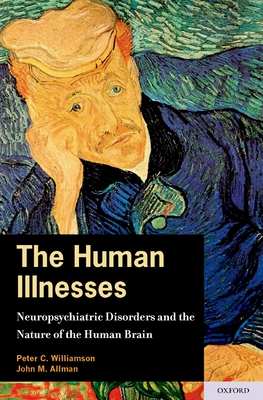
The Human Illnesses
Book Details
Format
Hardback
ISBN-10
0195368568
ISBN-13
9780195368567
Publisher
Oxford University Press Inc
Imprint
Oxford University Press Inc
Country of Manufacture
US
Country of Publication
GB
Publication Date
Feb 3rd, 2011
Print length
256 Pages
Weight
499 grams
Dimensions
15.70 x 23.60 x 2.00 cms
KSh 16,000.00
Currently unavailable
0 in stock
Delivery Location
Delivery fee: Select location
Secure
Quality
Fast
The Human Illnesses brings together a clinician and an evolutionary biologist to construct a sophisticated analysis of neuropsychiatric conditions and their history and findings as well as a biologist's perspective on what makes the human brain human in terms of histological, neuroanatomical, and functional imaging aspects.
The genetic correlates of neuropsychiatric disorders are now known, but none have come close to explaining the great variety of human psychiatric illnesses. This volume, written by a neuropsychiatrist and an evolutionary biologist, offers a new paradigm for understanding these disorders. Proposing that neuronal pathways which underlie neuropsychiatric conditions mirror unique human capabilities, the authors iterate a new paradigm by which to understand human psychiatric illnesses. Human capabilities such as theory of mind, language, and complex social behaviors are explored through their histological, neuroanatomical and functional brain imaging correlates.The capacity for representation, the authors suggest, is central to the understanding of the human brain. Brain structures such as the frontal pole, temporal pole, and fronto-insular cortex are highly developed in humans and are associated with representation. Other brain regions, including the dorsal anterior cingulate cortex, auditory cortex, and hippocampus, are linked with directed effort while the ventral anterior cingulate cortex, orbital frontal cortex, and amygdala are related to emotional encoding. Both networks interact with representional regions and the dorsolateral prefrontal cortex. Conditions like schizophrenia may result, in part, from a failure of the networks associated with directed effort while bipolar disorders may arise from a failure of networks associated with emotional encoding. Similarly, autism may result from a failure of representational brain regions; frontotemporal dementia may be associated with failure of several discrete networks in later life. From this perspective, neuropsychiatric disorders are selective failures of brain networks involved in the integration of cognition, affect and perception. A better understanding of these brain networks will assist psychiatric and mental health researchers in the search for environmental factors and genetic correlates of disorders as well as aid in the development of more effective treatments for these diseases. This volume will be of interest to psychiatrists, neurologists, psychologists, biologists, and imaging scientists--anyone who has ever wondered what makes the human brain human.
Get The Human Illnesses by John Allman, Peter Williamson at the best price and quality guaranteed only at Werezi Africa's largest book ecommerce store. The book was published by Oxford University Press Inc and it has 256 pages.
Customers Who Bought This Also Bought

Awakenings
KSh 2,000.00
Deep History of Ourselves
KSh 3,250.00

On the Move
KSh 2,350.00
Brainstorm
KSh 2,000.00
Anthropologist on Mars
KSh 2,000.00
Age of Diagnosis
KSh 3,950.00
Migraine
KSh 2,000.00

Reclaiming Your Life After Rape: Client Workbook
KSh 9,900.00

Advances and Technical Standards in Neurosurgery, Vol. 33
KSh 16,200.00

Rebuilding Your Life after Stroke
KSh 4,700.00

Chemical Signatures of the Brain
KSh 35,800.00
Cecile and Oskar Vogt
KSh 8,100.00
