
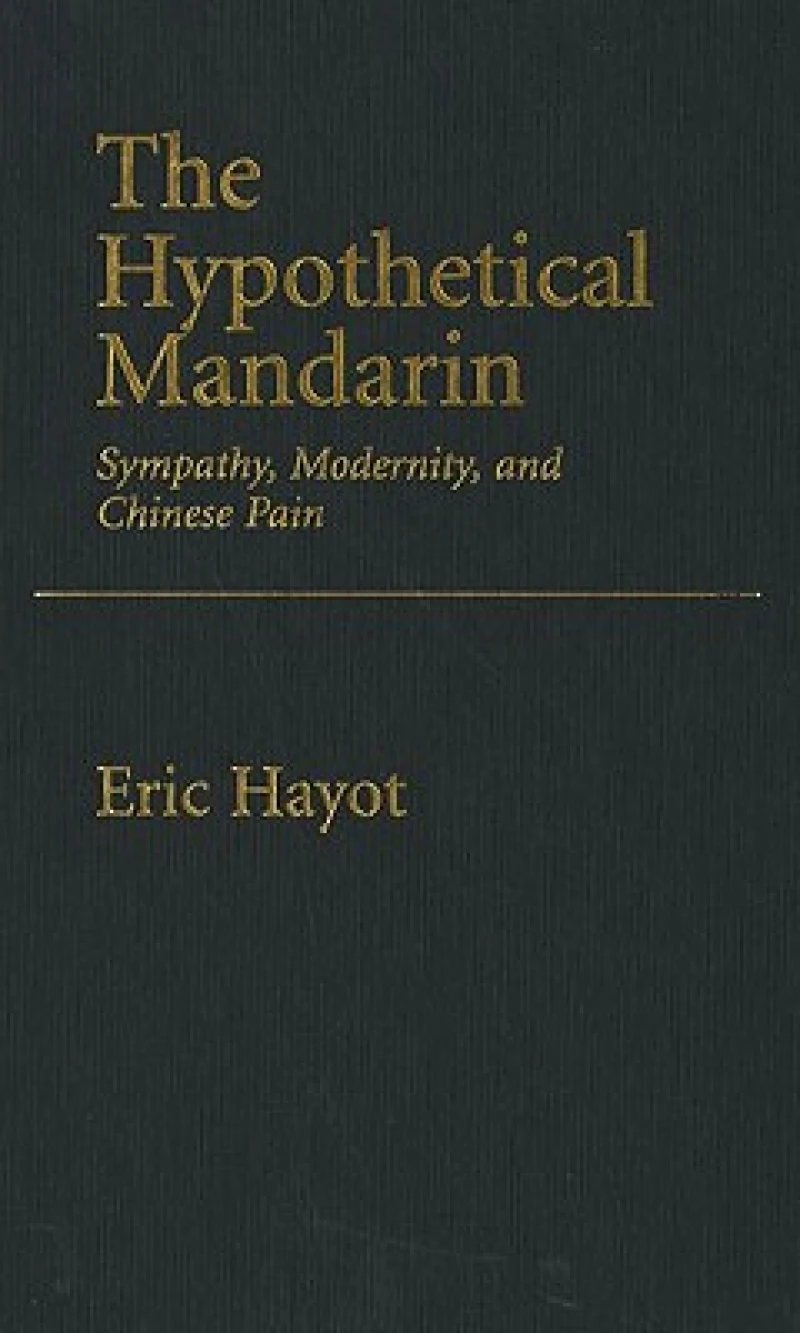
The Hypothetical Mandarin Sympathy, modernity, and Chinese Pain
by
Eric Hayot
Book Details
Format
Hardback or Cased Book
Book Series
Modernist Literature & Culture
ISBN-10
0195377966
ISBN-13
9780195377965
Publisher
Oxford University Press Inc
Imprint
Oxford University Press Inc
Country of Manufacture
US
Country of Publication
GB
Publication Date
Nov 5th, 2009
Print length
296 Pages
Weight
536 grams
Dimensions
16.00 x 23.60 x 2.50 cms
Product Classification:
Literary studies: c 1800 to c 1900 Literary studies: from c 1900 -
Ksh 11,600.00
Manufactured on Demand
0 in stock
Delivery Location
Delivery fee: Select location
Secure
Quality
Fast
Through readings of novels, medical case studies, travelers'' reports, photographs, and paintings, The Hypothetical Mandarin shows that in the West the connection between sympathy and humanity, and indeed between sympathy and reality, has tended to refract with a remarkable frequency through the lens called "China." Eric Hayot, through keen interpretations of myriad art forms and nonfictional writings, reveals how Western responses to Chinese pain go to the heart of the relationship between language and the body, the social and philosophical experience of modernity, and the definition of a universal human subject. In short, this analysis reveals how four terms-sympathy, suffering, economic exchange, and representational exchange-establish the network that frames the historical discourse on China, sympathy, and modernity. It is a book that opens new possibilities for thinking about the West''s relationship to China, past and present, and that establishes a new philosophical vantage from which to consider the question of empathy.
The Hypothetical Mandarin begins with two simple questions: Why has the West for so long and in so many different ways expressed the idea that the Chinese have a special relationship to cruelty and to physical pain? And what can the history of that idea and its expressions teach us about the politics of the West''s contemporary relation to China, and, more broadly, about the historical development of the universal subject of modernity? Insofar as it responds to those questions, the book is a history of the Western imagination. But it is also a history of the interactions between Enlightenment philosophy, the explosion in international commerce that dates from the eighteenth century and goes by the name of "globalization," theories of human rights, and the history of the idea of modernity. Beginning with Bianchon and Rastignac''s discussion of whether the latter would, if he could, obtain a European fortune by killing a Chinese mandarin in Balzac''s Le Père Goriot (1835), the book traces a series of literary and historical examples in which Chinese life and European sympathy seem to hang in one another''s balance. The representational and historical apparatus that produces these examples has organized the West''s explicit relation to China and served as a crucial mode of expression for the West''s most fundamental values. Through readings of novels, medical case studies, travelers'' reports, photographs, and paintings, the book shows that in the West the connection between sympathy and humanity, and indeed between sympathy and reality, has tended to refract with a remarkable frequency through the lens called "China." Western responses to Chinese pain go to the heart of the relationship between language and the body, the social and philosophical experience of modernity, and the definition of a universal human subject. This analysis opens new possibilities for thinking the West''s relationship to China, past and present, and concludes by showing how four terms-sympathy, suffering, economic exchange, and representational exchange-establish the network that frames the historical discourse on China, sympathy, and modernity, and continue to shape the economic and human experience of the present.
Get The Hypothetical Mandarin Sympathy, modernity, and Chinese Pain by at the best price and quality guaranteed only at Werezi Africa's largest book ecommerce store. The book was published by Oxford University Press Inc and it has pages.

