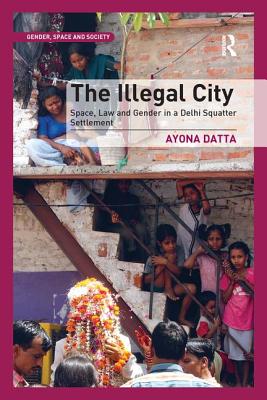
The Illegal City : Space, Law and Gender in a Delhi Squatter Settlement
by
Ayona Datta
Book Details
Format
Hardback
Book Series
Gender, Space and Society
ISBN-10
1409445542
ISBN-13
9781409445548
Publisher
Taylor & Francis Ltd
Imprint
Routledge
Country of Manufacture
GB
Country of Publication
GB
Publication Date
Sep 20th, 2012
Print length
216 Pages
Weight
540 grams
Dimensions
23.70 x 16.10 x 1.90 cms
KSh 33,850.00
Currently unavailable
0 in stock
Delivery Location
Delivery fee: Select location
Secure
Quality
Fast
Since 2000, a series of judicial rulings in India have criminalised squatters as 'illegal' citizens, 'encroachers' and 'pickpockets' of urban land, and have led to a spate of slum demolitions across the country. This book explores the relationship between space, law and gendered subjectivity by looking at an 'illegal' squatter settlement in Delhi.
The Illegal City explores the relationship between space, law and gendered subjectivity through a close look at an ''illegal'' squatter settlement in Delhi. Since 2000, a series of judicial rulings in India have criminalised squatters as ''illegal'' citizens, ''encroachers'' and ''pickpockets'' of urban land, and have led to a spate of slum demolitions across the country. This book argues that in this context, it has become vital to distinguish between illegality and informality since it is those ''illegal'' slums which are at the receiving end of a ''force of law'', where law is violently encountered within everyday spaces. This book uses a gendered intersectional lens to explore how a ''violence of law'' shapes how ''public'' subjectivities of gender, class, religion and caste are encountered and negotiated within the ''private'' spaces of home, family and neighbourhood. This book suggests that resettlement is not a condition that squatters desire; rather something that is seen as the only way out of the ''illegal'' city. The wait for resettlement is a temporal space of anxiety and uncertainty, where particular kinds of politics around law, space and gender takes shape, which transform squatters'' relations with the state, urban development, civil society, and with each other. Through their everyday struggles around water, sanitation, social and political organisation and the transformation of their homes and families, this book shows that the desire for the ''legal city'' is also the irony and utopia of home, which will remain an incomplete gendered project - both for the state and for squatters.
Get The Illegal City by Ayona Datta at the best price and quality guaranteed only at Werezi Africa's largest book ecommerce store. The book was published by Taylor & Francis Ltd and it has 216 pages.
Customers Who Bought This Also Bought

Crook Manifesto
KSh 2,700.00

Behind the Beautiful Forevers
KSh 2,000.00

The Keeper
KSh 1,800.00

Africa Is Not A Country
KSh 2,350.00

The Keeper
KSh 3,200.00

Slash and Burn
KSh 2,150.00

Slouching Towards Bethlehem
KSh 1,800.00

Strange Weather in Tokyo
KSh 1,800.00

The Coffeehouse
KSh 2,400.00

Heart of the Night
KSh 1,950.00

Frankenstein Urbanism
KSh 7,900.00
Amnesty
KSh 3,750.00