
The Imaginary Orient : Exotic Buildings of the 18th and 19th Centuries in Europe
Book Details
Format
Hardback or Cased Book
ISBN-10
3936681775
ISBN-13
9783936681772
Publisher
Edition Axel Menges
Imprint
Edition Axel Menges
Country of Manufacture
DE
Country of Publication
GB
Publication Date
Mar 31st, 2015
Print length
192 Pages
Weight
1,358 grams
Dimensions
31.30 x 25.50 x 2.20 cms
Product Classification:
History of architecture
Ksh 10,800.00
Werezi Extended Catalogue
0 in stock
Delivery Location
Delivery fee: Select location
Secure
Quality
Fast
In the eighteenth century the idea of the landscape garden spread all over Europe. At the same time the garden became the land of illusion: Chinese pagodas, Egyptian tombs and Turkish mosques, along with Gothic stables and Greek and Roman temples, formed a miniature world in which distance mingled with the past. The keen interest in a fairy-tale Orient was manifested also in architecture.
This "Orient", which could hardly be clearly defined geographically, was characterized by Islamic culture. The Islamic styles seemed especially appropriate for buildings of a secular and cheerful character. The promise of happiness associated with an Orient staged by architectural means was intended to guarantee the commercial success of coffee houses and music halls, amusement parks and steam baths. But even extravagant summer residences and middle-class villas were built in faux-Oriental styles.
This "Orient", which could hardly be clearly defined geographically, was characterized by Islamic culture. The Islamic styles seemed especially appropriate for buildings of a secular and cheerful character. The promise of happiness associated with an Orient staged by architectural means was intended to guarantee the commercial success of coffee houses and music halls, amusement parks and steam baths. But even extravagant summer residences and middle-class villas were built in faux-Oriental styles.
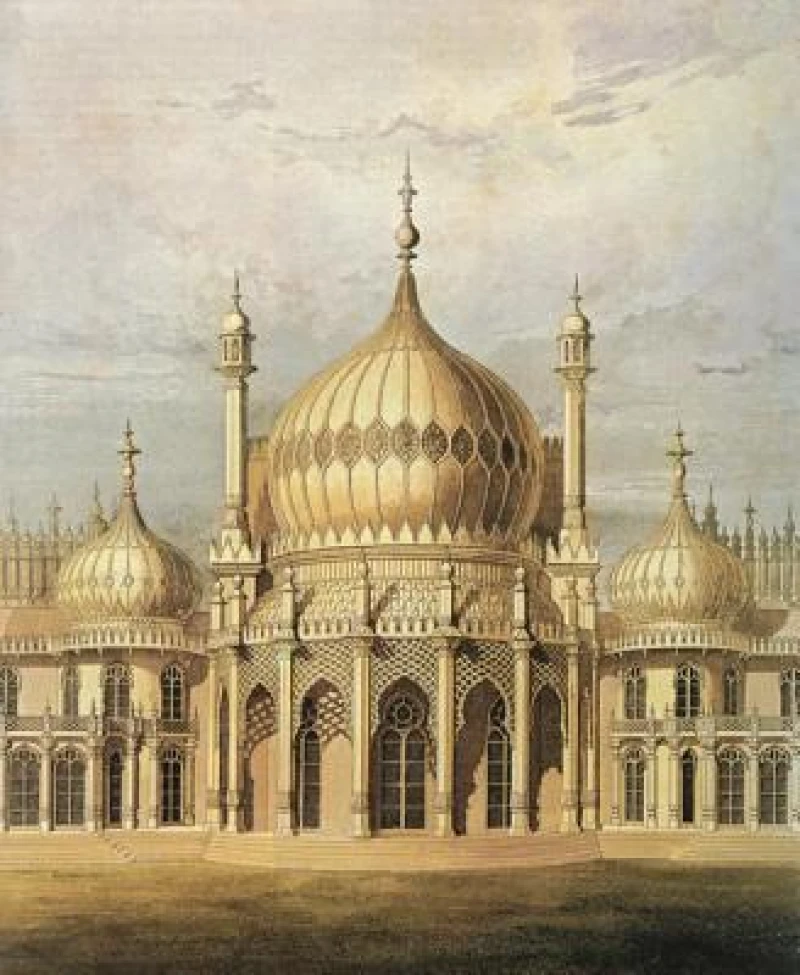
In the 18th century the idea of the landscape garden, which had originated in England, spread all over Europe. The geometry of the Baroque park was abandoned in favour of a 'natural' design. At the same time the garden became "The land of illusion": Chinese pagodas, Egyptian tombs, and Turkish mosques, along with Gothic stables and Greek and Roman temples, formed a miniature world in which distance mingled with the past. The keen interest in a fairy-tale China, which was manifested not only in the gardens but also in the chinoiseries of the Rococo, abated in the 19th century. The increasing expansion of the European colonial powers was reflected in new exotic fashions. While in England it was primarily the conquest of the Indian subcontinent that captured the imagination, for France the occupation of Algiers triggered an Orient-inspired fashion that spread from Paris to encompass the entire Continent, and found its expression in paintings, novels, operas, and buildings. This 'Orient', which could not be clearly defined geographically, was characterised by Islamic culture: It extended around the Mediterranean Sea from Constantinople to Granada. There, it was the Alhambra that fascinated writers and architects. The Islamic styles seemed especially appropriate for "buildings of a secular and cheerful character". In contrast to ancient Egyptian building forms, which, being severe and monumental, were preferably used for cemetery buildings, prisons or libraries, they promised earthly sensuous pleasures. The promise of happiness associated with an Orient staged by architectural means was intended to guarantee the commercial success of coffee houses and music halls, amusement parks, and steam baths. But even extravagant summer residences and middle-class villas were often built in faux-Oriental styles: In Brighton, the Prince Regent George (George IV after 1820) built himself an Indian palace; in Bad Cannstatt near Stuttgart, a 'Moorish' refuge was erected for Wurttemberg's King Wilhelm I; and the French town of Tourcoing was the site of the Palais du Congo, a bombastic villa in the Indian Moghul style that belonged to a wealthy perfume and soap manufacturer.
Get The Imaginary Orient by at the best price and quality guaranteed only at Werezi Africa's largest book ecommerce store. The book was published by Edition Axel Menges and it has pages.

