
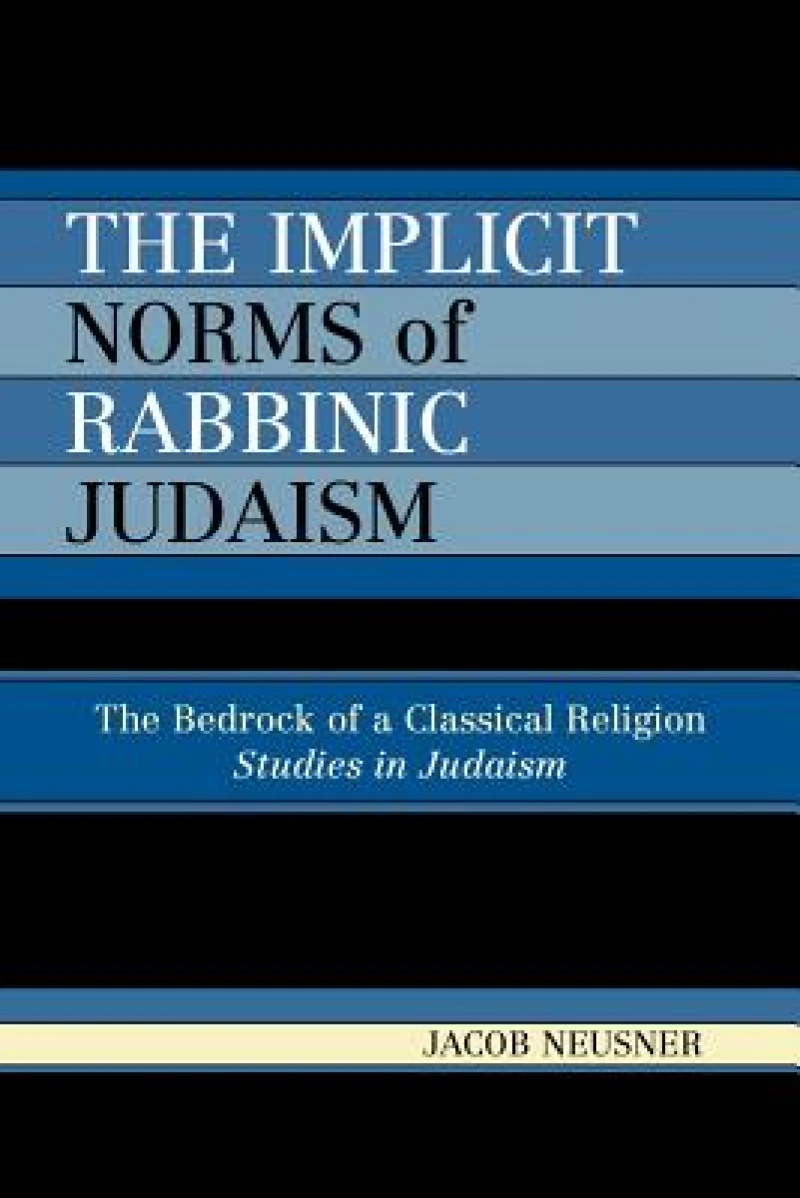
The Implicit Norms of Rabbinic Judaism : The Bedrock of a Classical Religion
Book Details
Format
Paperback / Softback
Book Series
Studies in Judaism
ISBN-10
0761833838
ISBN-13
9780761833833
Publisher
University Press of America
Imprint
University Press of America
Country of Manufacture
GB
Country of Publication
GB
Publication Date
Nov 28th, 2005
Print length
142 Pages
Weight
213 grams
Dimensions
22.80 x 17.70 x 1.30 cms
Product Classification:
Judaism
Ksh 7,600.00
Manufactured on Demand
0 in stock
Delivery Location
Delivery fee: Select location
Secure
Quality
Fast
Implicit norms of law and theology governed in Rabbinic Judaism from the onset of its canon in the Mishnah (concluded at ca. 200) to its climax in the Talmud of Babylonia four centuries later. These norms of conviction and conception prevailed in a complete system, which was logically present, if not fully realized, from the very beginning of the canon. Norms of belief, not only behavior, governed in the canonical documents of Rabbinic Judaism and defined its orthodoxy and its heterodoxy. This book proves that proposition by asking, what are the theological premises of the documents upon which the Rabbinic canon was built and do these premises cohere in a tight theological system? The Implicit Norms of Rabbinic Judaism answers this question by identifying the principles that had to govern in order for a given composition to be articulated or a particular composite to be assembled. Those premises at the foundations of the canonical documents prove not episodic, but coherent. The documents speak, so it is universally maintained, for the community of the Rabbinic sages that sponsored them. Hence the premises and presuppositions of a document represent the consensus of the Rabbinic sages: the implicit norms of attitude and action. Canonical orthodoxy and heresy come to definition in those norms. How individuals conformed, and what institutions functioned to enforce conformity, do not figure into this account. It suffices to show that orthodoxy and heresy constituted native categories of the Rabbinic system of thought inherent in principal documents of the canon.
Implicit norms of law and theology governed in Rabbinic Judaism from the onset of its canon in the Mishnah (concluded at ca. 200) to its climax in the Talmud of Babylonia four centuries later. These norms of conviction and conception prevailed in a complete system, which was logically present, if not fully realized, from the very beginning of the canon. Norms of belief, not only behavior, governed in the canonical documents of Rabbinic Judaism and defined its orthodoxy and its heterodoxy. This book proves that proposition by asking, what are the theological premises of the documents upon which the Rabbinic canon was built and do these premises cohere in a tight theological system? The Implicit Norms of Rabbinic Judaism answers this question by identifying the principles that had to govern in order for a given composition to be articulated or a particular composite to be assembled. Those premises at the foundations of the canonical documents prove not episodic, but coherent. The documents speak, so it is universally maintained, for the community of the Rabbinic sages that sponsored them. Hence the premises and presuppositions of a document represent the consensus of the Rabbinic sages: the implicit norms of attitude and action. Canonical orthodoxy and heresy come to definition in those norms. How individuals conformed, and what institutions functioned to enforce conformity, do not figure into this account. It suffices to show that orthodoxy and heresy constituted native categories of the Rabbinic system of thought inherent in principal documents of the canon.
Get The Implicit Norms of Rabbinic Judaism by at the best price and quality guaranteed only at Werezi Africa's largest book ecommerce store. The book was published by University Press of America and it has pages.

