
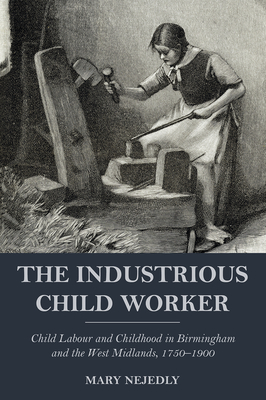
The Industrious Child Worker : Child labour and childhood in Birmingham and the West Midlands, 1750-1900
by
Mary Nejedly
Book Details
Format
Paperback / softback
ISBN-10
1912260433
ISBN-13
9781912260430
Publisher
University of Hertfordshire Press
Imprint
West Midlands Publications
Country of Manufacture
GB
Country of Publication
GB
Publication Date
Sep 1st, 2021
Print length
256 Pages
Weight
394 grams
Dimensions
23.40 x 15.60 x 1.60 cms
KSh 3,250.00
Currently unavailable
0 in stock
Delivery Location
Delivery fee: Select location
Secure
Quality
Fast
This book investigates the extent and nature of child labour in Birmingham and the West Midlands, from the mid-eighteenth century to the end of the nineteenth century. It considers the economic contributions of child workers under the age of 14 and the impact of early work on their health and education.
Studies of child labour have examined the experiences of child workers in agriculture, mining and textile mills, yet surprisingly little research has focused on child labour in manufacturing towns. This book investigates the extent and nature of child labour in Birmingham and the West Midlands, from the mid-eighteenth century to the end of the nineteenth century. It considers the economic contributions of child workers under the age of 14 and the impact of early work on their health and education. Child labour in the region was not a short-lived stage of the early Industrial Revolution but an integral part of industry throughout the nineteenth century. Parents regarded their children as potentially valuable contributors to the family economy, encouraging families to migrate from rural areas so that their children could work from an early age in the manufacture of pins, nails, buttons, glass, locks and guns as well as tin-plating, carpet-weaving, brass-casting and other industries. The demand for young workers in Birmingham was greater than that for adults; in Mary Nejedly's detailed analysis the importance of children'searnings to the family economy becomes clear, as well as the role played by child workers in industrialisation itself. In view of the economic benefit of children's labour to families as well as employers, both children's education and health could and did suffer. As well as working at harmful processes that produced dangerous fumes and dust or exposed them to poisonous substances, children also suffered injuries in the workplace, mainly to the head, eyes and fingers, and were often subjected to ill-treatment from adult workers. The wide gulf in economic circumstances that existed between the families of skilled workers and those of unskilled workers, unemployed workers or single-parent families also becomes evident. Attitudes towards childhood changed over the course of the period, however, with a greater emphasis being placed on the role of education for all children as a means of reducing pauperism and dependence on the poor rate. Concerns about health also gradually emerged, together with laws to limit work for children both by age and hours worked. Mary Nejedly's clear-eyed research sheds fresh light on the life of working children and increases our knowledge of an important aspect of social and economic history.
Get The Industrious Child Worker by Mary Nejedly at the best price and quality guaranteed only at Werezi Africa's largest book ecommerce store. The book was published by University of Hertfordshire Press and it has 256 pages.
Customers Who Bought This Also Bought
The Finest Hotel in Kabul
KSh 2,150.00

Black Wave
KSh 2,700.00

Migrations
KSh 5,450.00
Art of War / The Book of Lord Shang
KSh 1,100.00

Nexus
KSh 2,350.00

World According to Colour
KSh 2,700.00
Crusade for Justice – The Autobiography of Ida B. Wells, Second Edition
KSh 4,050.00
Modern Classics Road To Wigan Pier
KSh 1,800.00
The Origins of Totalitarianism
KSh 2,700.00
In the Wake
KSh 3,600.00

Question of Palestine
KSh 2,700.00

Palestine
KSh 2,400.00
