
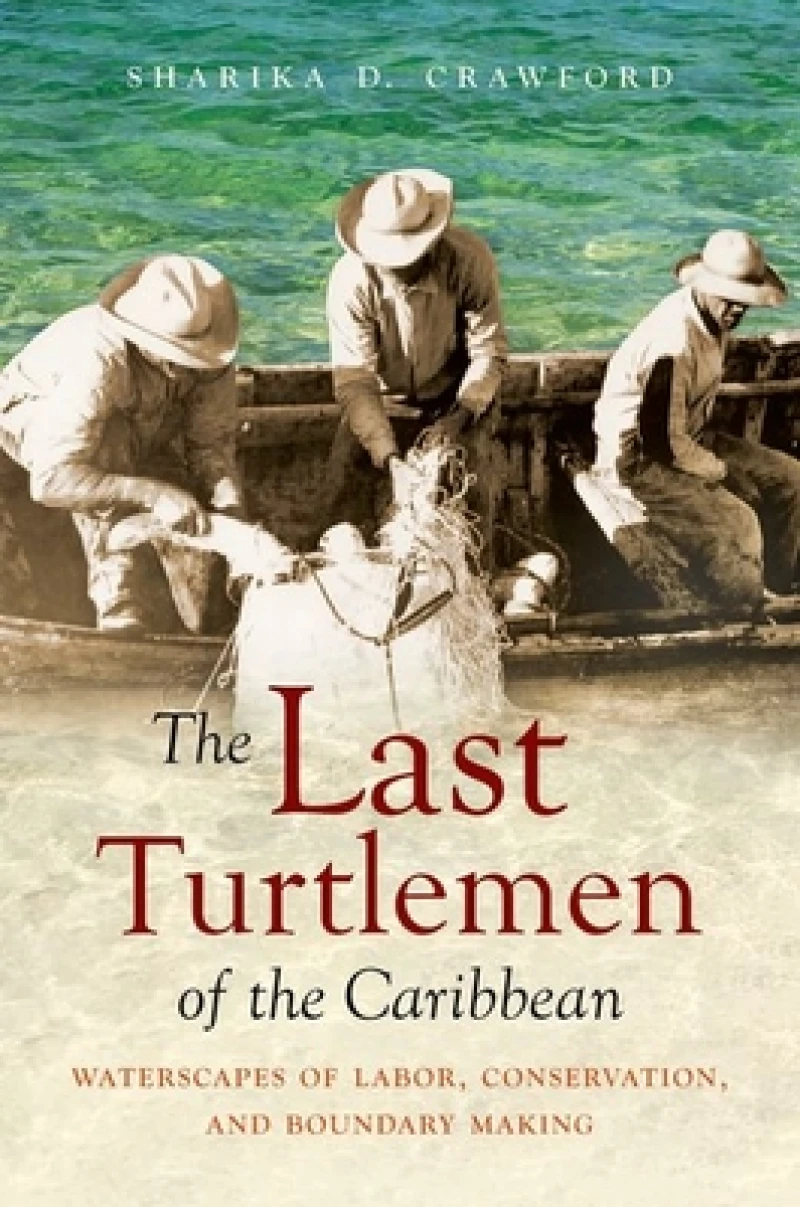
The Last Turtlemen of the Caribbean : Waterscapes of Labor, Conservation, and Boundary Making
Book Details
Format
Paperback / Softback
Book Series
Flows, Migrations, and Exchanges
ISBN-10
1469660210
ISBN-13
9781469660219
Publisher
The University of North Carolina Press
Imprint
The University of North Carolina Press
Country of Manufacture
US
Country of Publication
GB
Publication Date
Oct 26th, 2020
Print length
216 Pages
Weight
335 grams
Dimensions
23.30 x 15.50 x 1.20 cms
Ksh 4,850.00
Werezi Extended Catalogue
0 in stock
Delivery Location
Delivery fee: Select location
Secure
Quality
Fast
Illuminating the entangled histories of the people and commodities that circulated across the Atlantic, Sharika Crawford assesses the Caribbean as a waterscape where imperial and national governments vied to control the profitability of the sea.
The labor of turtle hunters and the shaping of Caribbean history.
Illuminating the entangled histories of the people and commodities that circulated across the Atlantic, Sharika D. Crawford assesses the Caribbean as a waterscape where imperial and national governments vied to control the profitability of the sea. Crawford places the green and hawksbill sea turtles and the Caymanian turtlemen who hunted them at the center of this waterscape. The story of the humble turtle and its hunter, she argues, came to play a significant role in shaping the maritime boundaries of the modern Caribbean.
Crawford describes the colonial Caribbean as an Atlantic commons where all could compete to control the region's diverse peoples, lands, and waters and exploit the region's raw materials. Focusing on the nineteenth and twentieth centuries, Crawford traces and connects the expansion and decline of turtle hunting to matters of race, labor, political and economic change, and the natural environment. Like the turtles they chased, the boundary-flouting laborers exposed the limits of states' sovereignty for a time but ultimately they lost their livelihoods, having played a significant role in legislation delimiting maritime boundaries. Still, former turtlemen have found their deep knowledge valued today in efforts to protect sea turtles and recover the region's ecological sustainability.
Illuminating the entangled histories of the people and commodities that circulated across the Atlantic, Sharika D. Crawford assesses the Caribbean as a waterscape where imperial and national governments vied to control the profitability of the sea. Crawford places the green and hawksbill sea turtles and the Caymanian turtlemen who hunted them at the center of this waterscape. The story of the humble turtle and its hunter, she argues, came to play a significant role in shaping the maritime boundaries of the modern Caribbean.
Crawford describes the colonial Caribbean as an Atlantic commons where all could compete to control the region's diverse peoples, lands, and waters and exploit the region's raw materials. Focusing on the nineteenth and twentieth centuries, Crawford traces and connects the expansion and decline of turtle hunting to matters of race, labor, political and economic change, and the natural environment. Like the turtles they chased, the boundary-flouting laborers exposed the limits of states' sovereignty for a time but ultimately they lost their livelihoods, having played a significant role in legislation delimiting maritime boundaries. Still, former turtlemen have found their deep knowledge valued today in efforts to protect sea turtles and recover the region's ecological sustainability.
Get The Last Turtlemen of the Caribbean by at the best price and quality guaranteed only at Werezi Africa's largest book ecommerce store. The book was published by The University of North Carolina Press and it has pages.

