
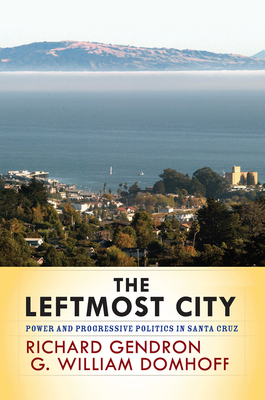
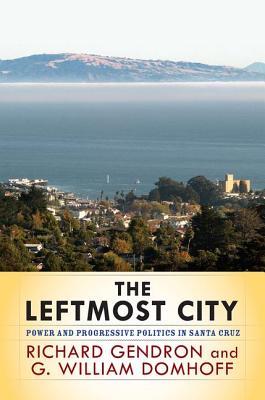
The Leftmost City : Power and Progressive Politics in Santa Cruz
Book Details
Format
Hardback
ISBN-10
0367097184
ISBN-13
9780367097189
Publisher
Taylor & Francis Ltd
Imprint
Routledge
Country of Manufacture
GB
Country of Publication
GB
Publication Date
Jun 13th, 2019
Print length
256 Pages
Weight
453 grams
Product Classification:
Society and culture: generalSociety & culture: general
KSh 30,950.00
Currently unavailable
0 in stock
Delivery Location
Delivery fee: Select location
Secure
Quality
Fast
Drawing on hundreds of primary documents, as well as original, previously unpublished interviews, The Leftmost City utilizes an extended case study of Santa Cruz to critique three major theories of urban power: Marxism, public-choice theory, and regime theory.
Almost all US cities are controlled by real estate and development interests, but Santa Cruz, California, is a deviant case. An unusual coalition of socialist-feminists, environmentalists, social-welfare liberals, and neighborhood activists has stopped every growth project proposed by landowners and developers since 1969, and controlled the city council since 1981. Even after a 1989 earthquake forced the city to rebuild its entire downtown, the progressive elected officials prevailed over developers and landowners. Drawing on hundreds of primary documents, as well as original, previously unpublished interviews, The Leftmost City utilizes an extended case study of Santa Cruz to critique three major theories of urban power: Marxism, public-choice theory, and regime theory. Santa Cruz is presented within the context of other progressive attempts to shape city government, and the authors'' findings support growth-coalition theory, which stresses the conflict between real estate interests and neighborhoods as the fundamental axis of urban politics. The authors conclude their analysis by applying insights gleaned from Santa Cruz to progressive movements nationwide, offering a template for progressive coalitions to effectively organize to achieve political power.
Get The Leftmost City by G. William Domhoff, Richard Gendron at the best price and quality guaranteed only at Werezi Africa's largest book ecommerce store. The book was published by Taylor & Francis Ltd and it has 256 pages.
Customers Who Bought This Also Bought

Africa Dances
KSh 2,700.00
Its Our Turn to Eat
KSh 2,350.00
Stranger Faces
KSh 2,500.00
The 48 Laws Of Power
KSh 3,600.00

Wild Seed
KSh 2,350.00
Patternmaster
KSh 2,350.00

Clay's Ark
KSh 2,350.00

Mind of My Mind
KSh 2,350.00

Clay''s Ark
KSh 2,000.00

Mind of My Mind
KSh 2,000.00

Biased
KSh 2,150.00
Identity
KSh 2,150.00
More by G. William Domhoff, Richard Gendron
Diversity in the Power Elite
KSh 7,000.00
Studying the Power Elite
KSh 7,550.00
The Corporate Rich and the Power Elite in the Twentieth Century
KSh 11,000.00
Diversity in the Power Elite
KSh 17,100.00
New CEOs
KSh 6,850.00
The Mystique of Dreams
KSh 4,500.00

The Neurocognitive Theory of Dreaming
KSh 8,650.00
The Corporate Rich and the Power Elite in the Twentieth Century
KSh 37,800.00
New CEOs
KSh 9,000.00
The Leftmost City
KSh 7,900.00
Studying the Power Elite
KSh 37,800.00
