
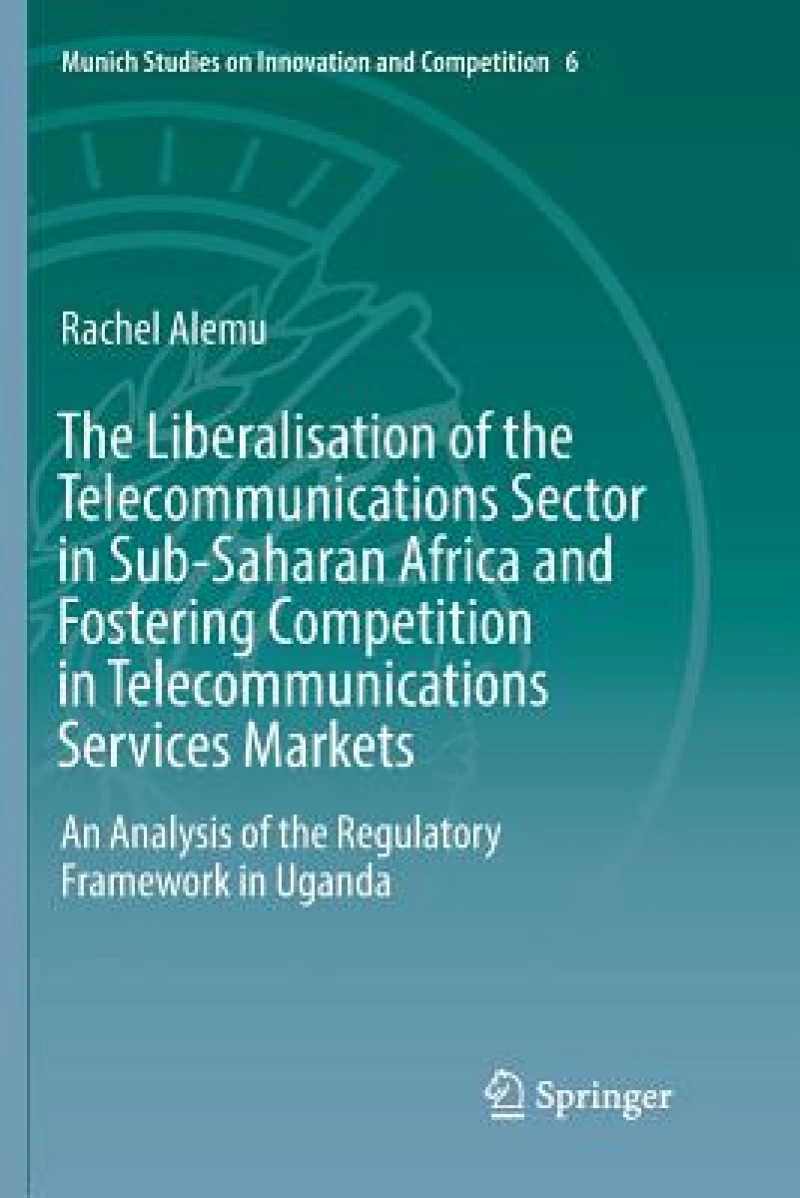
The Liberalisation of the Telecommunications Sector in Sub-Saharan Africa and Fostering Competition in Telecommunications Services Markets : An Analysis of the Regulatory Framework in Uganda
Softcover reprint of the original 1st ed. 2018
by
Rachel Alemu
Book Details
Format
Paperback / Softback
Book Series
Munich Studies on Innovation and Competition
ISBN-10
366257229X
ISBN-13
9783662572290
Edition
Softcover reprint of the original 1st ed. 2018
Publisher
Springer-Verlag Berlin and Heidelberg GmbH & Co. KG
Imprint
Springer-Verlag Berlin and Heidelberg GmbH & Co. K
Country of Manufacture
DE
Country of Publication
GB
Publication Date
Jun 4th, 2019
Print length
389 Pages
Ksh 16,200.00
Werezi Extended Catalogue
0 in stock
Delivery Location
Delivery fee: Select location
Secure
Quality
Fast
This study investigates whether the existing regulatory framework governing the telecommunications sector in countries in Sub-Saharan Africa effectively deals with emerging competition-related concerns in the liberalised sector.
This study investigates whether the existing regulatory framework governing the telecommunications sector in countries in Sub-Saharan Africa effectively deals with emerging competition-related concerns in the liberalised sector. Using Uganda as a case study, it analyses the relevant provisions of the law governing competition in the telecommunications sector, and presents three key findings: Firstly, while there is comprehensive legislation on interconnection and spectrum management, inefficient enforcement of the legislation has perpetuated concerns surrounding spectrum scarcity and interconnection. Secondly, the legislative framework governing anti-competitive behaviour, though in line with the established principles of competition law, is not sufficient. Specifically, the framework is not equipped to govern the conduct of multinational telecommunications groups that have a strong presence in the telecommunications sector. Major factors hampering efficient competition regulation include Uganda''s sole reliance on sector-specific competition rules, restricted available remedies, and a regulator with limited experience of enforcing competition legislation. The weaknesses in the framework strongly suggest the need to adopt an economy-wide competition law. Lastly, wireless technology is the main means through which the population in Uganda accesses telecommunications services. Greater emphasis should be placed on regulating conduct in the wireless communications markets.
Get The Liberalisation of the Telecommunications Sector in Sub-Saharan Africa and Fostering Competition in Telecommunications Services Markets by at the best price and quality guaranteed only at Werezi Africa's largest book ecommerce store. The book was published by Springer-Verlag Berlin and Heidelberg GmbH & Co. KG and it has pages.

