
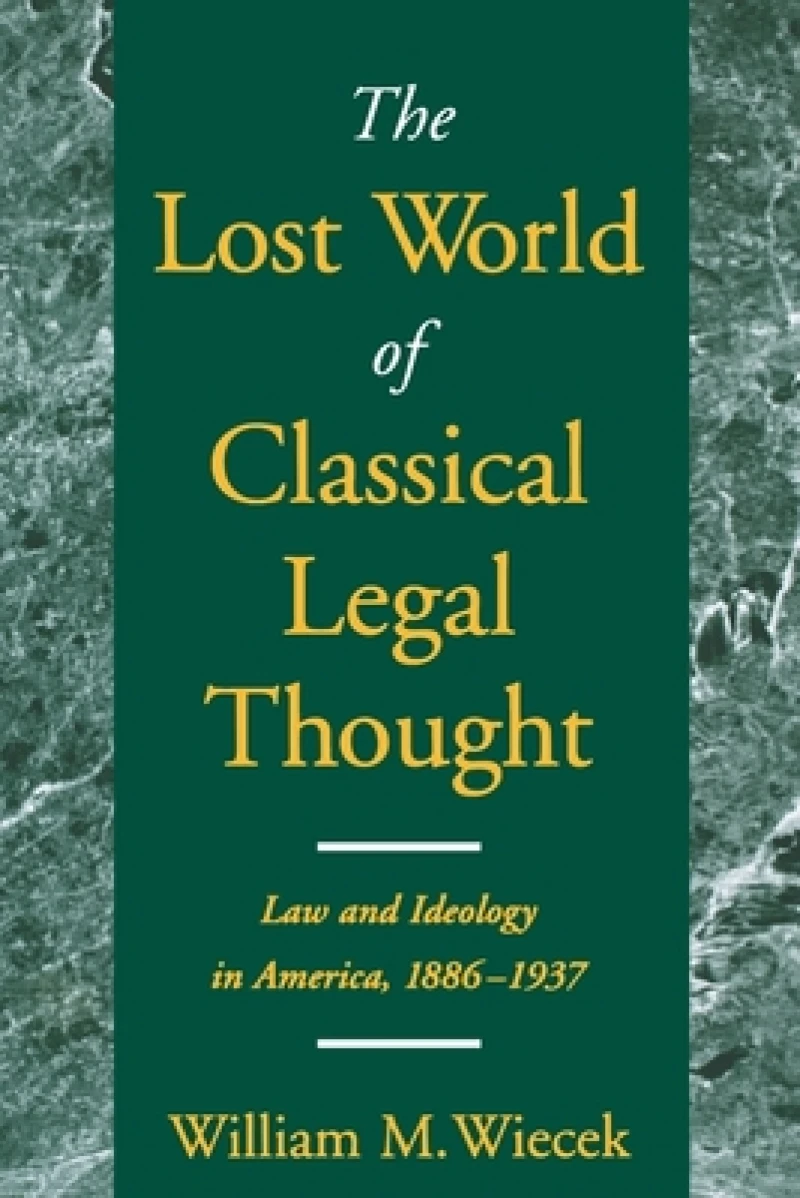
The Lost World of Classical Legal Thought : Law and Ideology in America, 1886-1937
Book Details
Format
Paperback / Softback
ISBN-10
0195147138
ISBN-13
9780195147131
Publisher
Oxford University Press
Imprint
Oxford University Press
Country of Manufacture
GB
Country of Publication
GB
Publication Date
Jun 21st, 2001
Print length
296 Pages
Weight
422 grams
Dimensions
23.50 x 15.90 x 2.10 cms
Ksh 6,900.00
Manufactured on Demand
0 in stock
Delivery Location
Delivery fee: Select location
Secure
Quality
Fast
This book examines legal ideology in America from the height of the Gilded Age through the time of the New Deal, when the Supreme Court began to discard orthodox thought in favour of more modernist approaches to law. Wiecek places this era of legal thought in its historical context, integrating social, economic, and intellectual analyses.
This book examines the ideology of elite lawyers and judges from the Gilded Age through the New Deal. Between 1866 and 1937, a coherent outlook shaped the way the American bar understood the sources of law, the role of the courts, and the relationship between law and the larger society. William M. Wiecek explores this outlook--often called "legal orthodoxy" or "classical legal thought"--which assumed that law was apolitical, determinate, objective, and neutral. American classical legal thought was forged in the heat of the social crises that punctuated the late nineteenth century. Fearing labor unions, immigrants, and working people generally, American elites, including those on the bench and bar, sought ways to repress disorder and prevent political majorities from using democratic processes to redistribute wealth and power. Classical legal thought provided a rationale that assured the legitimacy of the extant distribution of society''s resources. It enabled the legal suppression of unions and the subordination of workers to management''s authority. As the twentieth-century U.S. economy grew in complexity, the antiregulatory, individualistic bias of classical legal thought became more and more distanced from reality. Brittle and dogmatic, legal ideology lost legitimacy in the eyes of both laypeople and ever-larger segments of the bar. It was at last abandoned in the "constitutional revolution of 1937", but--as Wiecek argues in this detailed analysis--nothing has arisen since to replace it as an explanation of what law is and why courts have such broad power in a democratic society.
Get The Lost World of Classical Legal Thought by at the best price and quality guaranteed only at Werezi Africa's largest book ecommerce store. The book was published by Oxford University Press and it has pages.

