
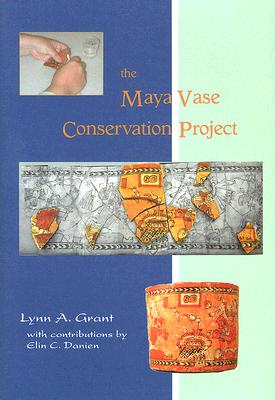
The Maya Vase Conservation Project
Book Details
Delivery Location
Delivery fee: Select location
Museum goers are always fascinated by behind-the-schemes glimpses of the way museum professionals prepare artifacts and works of art for exhibit and study. In this richly illustrated, step-by-step presentation, Grant describes the problems of conserving and preserving the only provenienced collection of a group of 19 important Maya vases excavated early in the twentieth century in Chama, Guatemala, by Robert Burkitt, an early investigator for the University Museum. This polychrome pottery was crafted in a unique style that emerged suddenly, flowered briefly in the early eighth century AD, and within 50 years ceased to be made. The gifted Chamá artists, whose control of color, line, and composition has been admired by collectors as well as curators, were also appreciated by other ancient Maya artists, who placed pictures of Chamá-style vessels in the narrative scenes painted on other polychromes.
Yet almost nothing is known archaeologically about this Maya site, its people, the reasons for the ceramic florescence, or for its demise. Grant explains the conservation process in lay terms, discussing why conservation is necessary, how it is done, what materials are used, and what the results are. The clearly accessible narrative, with full-color photographs illustrating all steps of the process to complement the text, includes such topics as the importance of the pots to Maya studies, their early excavation history, why they needed conservation, what the conservation process entails, how conservators do what they do and why, and special documentation techniques including multispectral imaging and residue analysis.
While the book focuses on conservation rather than the individual vessels, an accompanying CD-ROM, with 280 full-color images, illustrates each of the vessels before, during, and after treatment. Content of the book''s CD-ROM may be found online at this location: http://core.tdar.org/project/376581.
Get The Maya Vase Conservation Project by Elin C. Danien, Lynn A. Grant at the best price and quality guaranteed only at Werezi Africa's largest book ecommerce store. The book was published by University of Pennsylvania Press and it has 128 pages.
Customers Who Bought This Also Bought

To the Sea by Train
KSh 3,400.00
The Artist as Curator
KSh 6,650.00

Theorising the Artist Interview
KSh 30,950.00
Remembering Enslavement
KSh 7,900.00

Cleaning
KSh 30,950.00

Conservation of Natural History Specimens
KSh 46,800.00
Elusive Archives
KSh 15,500.00

Intangible Cultural Heritage Law and the Digital Era
KSh 30,950.00
Remembering Enslavement
KSh 26,700.00

Cleaning
KSh 7,200.00

Fragmented Illuminations
KSh 9,000.00

Fragmented Illuminations
KSh 5,400.00
More by Elin C. Danien, Lynn A. Grant
The World of Philip and Alexander – A Symposium on Greek Life and Times
KSh 3,500.00

Guide to the Mesoamerican Gallery at the University of Pennsylvania Museum of Archaeology and Anthropology
KSh 6,800.00

New Theories on the Ancient Maya
KSh 10,100.00

Guide to the Mesoamerican Gallery at the University of Pennsylvania Museum of Archaeology and Anthropology
KSh 3,150.00
