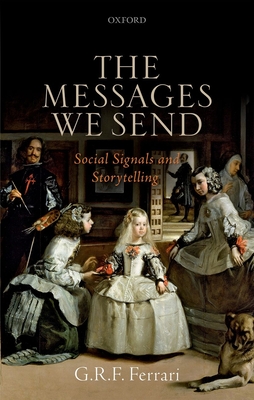
The Messages We Send : Social Signals and Storytelling
Book Details
Format
Hardback
ISBN-10
0198798423
ISBN-13
9780198798422
Publisher
Oxford University Press
Imprint
Oxford University Press
Country of Manufacture
GB
Country of Publication
GB
Publication Date
Sep 28th, 2017
Print length
204 Pages
Weight
387 grams
Dimensions
24.20 x 16.20 x 3.00 cms
Product Classification:
Philosophy of languageSociolinguisticsLiterary theorySocial, group or collective psychology
KSh 9,300.00
Currently unavailable
0 in stock
Delivery Location
Delivery fee: Select location
Secure
Quality
Fast
G. R. F. Ferrari offers a new framework for understanding ways in which we communicate with each other. He explores the idea of "intimations": social interactions that approach outright communication but do not quite reach it. He considers poetry, storytelling, and fashion as examples of different levels of communication.
G. R. F. Ferrari offers a new framework for understanding different ways in which we communicate with each other. He explores the idea of "intimations": social interactions that approach outright communication but do not quite reach it. The metaphor from which he starts is that of a communicative scale or switch, which goes from "off" (no communication intended) to fully "on" (outright communication). Intimations lie in between. Three intermediate positions are identified: quarter-on, half-on, and three-quarters-on. Progression along the communicative scale is determined by the extent to which what comes across in the transmission is required to come across by recognition of the intention of the transmitting party. At a quarter-on, it is required not to; at half-on, it is neither required to nor required not to; at three-quarters-on, it is required to, but only partially; at full-on, it is required to, and the recognition is complete. The half-on intimation is primarily used for impression-management in social life. To illustrate it, the book concentrates on fashion and the "messages" we send with our clothes. With the quarter-on and three-quarters-on intimation, the focus of argument is on the fact that transmissions at the same position of the communicative scale have the same underlying structure, whether they are made in the formal arts or in daily life outside the arts. For the quarter-on intimation, the formal art is lyric poetry; for the three-quarters-on intimation, it is storytelling. The book discusses storytelling at length, and at the end investigates its connection to situational irony.
Get The Messages We Send by G. R. F. Ferrari at the best price and quality guaranteed only at Werezi Africa's largest book ecommerce store. The book was published by Oxford University Press and it has 204 pages.
Customers Who Bought This Also Bought

Recognising the Stranger
KSh 1,800.00

The Origin of Language
KSh 4,500.00
Sharing Thoughts
KSh 17,000.00

An Inquiry Into Meaning and Truth
KSh 3,750.00

Semiotics and the Philosophy of Language
KSh 3,400.00

An Introduction to Logic
KSh 6,650.00

Walker Percy''s Search for Community
KSh 5,950.00

Film Figures
KSh 16,450.00

The Tacit Dimensions of Language and Logic
KSh 15,800.00

Metaphors in Action
KSh 21,600.00

Frontiers in Semiotics
KSh 3,000.00

A Theory of Death
KSh 11,900.00