
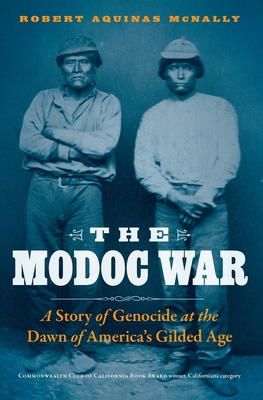
The Modoc War : A Story of Genocide at the Dawn of America's Gilded Age
Book Details
Format
Paperback / softback
ISBN-10
1496224914
ISBN-13
9781496224910
Publisher
University of Nebraska Press
Imprint
University of Nebraska Press
Country of Manufacture
US
Country of Publication
GB
Publication Date
Apr 1st, 2021
Print length
432 Pages
Weight
616 grams
Dimensions
22.50 x 14.60 x 3.10 cms
Product Classification:
United States of America, USA19th century, c 1800 to c 18991861–1877 (American Civil War period and the era of Reconstruction)Relating to Native American people / First AmericansHistory of the AmericasModern history to 20th century: c 1700 to c 1900Social & cultural historyEthnic groups and multicultural studiesIndigenous peoples / IndigeneityEthnic minorities & multicultural studiesIndigenous peoplesHistoryHistory of the AmericasSocial and cultural history
KSh 3,800.00
Currently unavailable
0 in stock
Delivery Location
Delivery fee: Select location
Secure
Quality
Fast
Commonwealth Club of California Book Award winner, Californiana category
On a cold, rainy dawn in late November 1872, Lieutenant Frazier Boutelle and a Modoc Indian nicknamed Scarface Charley leveled firearms at each other. Their duel triggered a war that capped a decades-long genocidal attack emblematic of the United States’ conquest of Native America’s peoples and lands. Robert Aquinas McNally tells the wrenching story of the Modoc War of 1872–73, one of the nation’s costliest campaigns against North American Indigenous peoples, in which the army placed nearly one thousand soldiers in the field against some fifty-five Modoc fighters.
Although little known today, the Modoc War dominated national headlines for an entire year. Fought in south-central Oregon and northeastern California, the war settled into a siege in the desolate Lava Beds and climaxed the decades-long effort to dispossess and destroy the Modocs. The war did not end with the last shot fired, however. For the first and only time in U.S. history, Native fighters were tried and hanged for war crimes. The surviving Modocs were packed into cattle cars and shipped from Fort Klamath to the corrupt, disease-ridden Quapaw reservation in Oklahoma, where they found peace even more lethal than war.
The Modoc War tells the forgotten story of a violent and bloody Gilded Age campaign at a time when the federal government boasted officially of a “peace policy” toward Indigenous nations. This compelling history illuminates a dark corner in our country’s past.
On a cold, rainy dawn in late November 1872, Lieutenant Frazier Boutelle and a Modoc Indian nicknamed Scarface Charley leveled firearms at each other. Their duel triggered a war that capped a decades-long genocidal attack emblematic of the United States’ conquest of Native America’s peoples and lands. Robert Aquinas McNally tells the wrenching story of the Modoc War of 1872–73, one of the nation’s costliest campaigns against North American Indigenous peoples, in which the army placed nearly one thousand soldiers in the field against some fifty-five Modoc fighters.
Although little known today, the Modoc War dominated national headlines for an entire year. Fought in south-central Oregon and northeastern California, the war settled into a siege in the desolate Lava Beds and climaxed the decades-long effort to dispossess and destroy the Modocs. The war did not end with the last shot fired, however. For the first and only time in U.S. history, Native fighters were tried and hanged for war crimes. The surviving Modocs were packed into cattle cars and shipped from Fort Klamath to the corrupt, disease-ridden Quapaw reservation in Oklahoma, where they found peace even more lethal than war.
The Modoc War tells the forgotten story of a violent and bloody Gilded Age campaign at a time when the federal government boasted officially of a “peace policy” toward Indigenous nations. This compelling history illuminates a dark corner in our country’s past.
Get The Modoc War by Robert Aquinas McNally at the best price and quality guaranteed only at Werezi Africa's largest book ecommerce store. The book was published by University of Nebraska Press and it has 432 pages.
Customers Who Bought This Also Bought
Crusade for Justice – The Autobiography of Ida B. Wells, Second Edition
KSh 4,050.00

Killers of the Flower Moon
KSh 2,000.00

Warmth of Other Suns
KSh 3,050.00

Frederick Douglass
KSh 3,350.00

107 Days
KSh 4,500.00

Second Treatise of Government – Norton Library
KSh 1,600.00

Tuesdays With Morrie
KSh 2,000.00
My Bondage and My Freedom
KSh 1,600.00

Hidden Figures
KSh 2,000.00
America, América
KSh 3,650.00
Holding the Line
KSh 2,000.00

Nuclear Folly
KSh 3,050.00

