
Cart 0
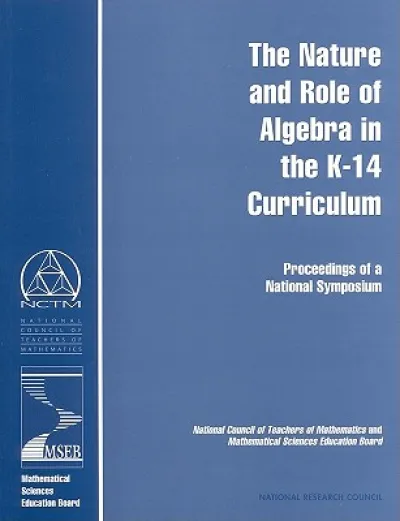
The Nature and Role of Algebra in the K-14 Curriculum
Click to zoom

Share this book

Book Details

Format Paperback / Softback
ISBN-10 0309061474
ISBN-13 9780309061476
Publisher National Academies Press
Imprint National Academies Press
Country of Manufacture GB
Country of Publication GB
Publication Date Oct 23rd, 1998
Print length 206 Pages
Ksh 9,000.00
Re-Printing

Delivery Location

Delivery fee: Select location

Secure
Quality
Fast
With the 1989 release of Everybody Counts by the Mathematical Sciences Education Board (MSEB) of the National Research Council and the Curriculum and Evaluation Standards for School Mathematics by the National Council of Teachers of Mathematics (NCTM), the "standards movement" in K-12 education was launched. Since that time, the MSEB and the NCTM have remained committed to deepening the public debate, discourse, and understanding of the principles and implications of standards-based reform. One of the main tenets in the NCTM Standards is commitment to providing high-quality mathematical experiences to all students. Another feature of the Standards is emphasis on development of specific mathematical topics across the grades. In particular, the Standards emphasize the importance of algebraic thinking as an essential strand in the elementary school curriculum. Issues related to school algebra are pivotal in many ways. Traditionally, algebra in high school or earlier has been considered a gatekeeper, critical to participation in postsecondary education, especially for minority students. Yet, as traditionally taught, first-year algebra courses have been characterized as an unmitigated disaster for most students. There have been many shifts in the algebra curriculum in schools within recent years. Some of these have been successful first steps in increasing enrollment in algebra and in broadening the scope of the algebra curriculum. Others have compounded existing problems. Algebra is not yet conceived of as a K-14 subject. Issues of opportunity and equity persist. Because there is no one answer to the dilemma of how to deal with algebra, making progress requires sustained dialogue, experimentation, reflection, and communication of ideas and practices at both the local and national levels. As an initial step in moving from national-level dialogue and speculations to concerted local and state level work on the role of algebra in the curriculum, the MSEB and the NCTM co-sponsored a national symposium, "The Nature and Role of Algebra in the K-14 Curriculum," on May 27 and 28, 1997, at the National Academy of Sciences in Washington, D.C. Table of ContentsFront MatterIntroductionOpening RemarksKeynote AddressesPresentations on Day OneSynthesis of Day OnePresentations on Day TwoClosing RemarksAppendix A: Symposium AgendaAppendix B: List of ParticipantsAppendix C: Speaker BiographiesAppendix D: Invited PapersAppendix E: A Framework for Constructing a Vision of Algebra: A Discussion Document

With the 1989 release of Everybody Counts by the Mathematical Sciences Education Board (MSEB) of the National Research Council and the Curriculum and Evaluation Standards for School Mathematics by the National Council of Teachers of Mathematics (NCTM), the "standards movement" in K-12 education was launched. Since that time, the MSEB and the NCTM have remained committed to deepening the public debate, discourse, and understanding of the principles and implications of standards-based reform. One of the main tenets in the NCTM Standards is commitment to providing high-quality mathematical experiences to all students. Another feature of the Standards is emphasis on development of specific mathematical topics across the grades. In particular, the Standards emphasize the importance of algebraic thinking as an essential strand in the elementary school curriculum.

Issues related to school algebra are pivotal in many ways. Traditionally, algebra in high school or earlier has been considered a gatekeeper, critical to participation in postsecondary education, especially for minority students. Yet, as traditionally taught, first-year algebra courses have been characterized as an unmitigated disaster for most students. There have been many shifts in the algebra curriculum in schools within recent years. Some of these have been successful first steps in increasing enrollment in algebra and in broadening the scope of the algebra curriculum. Others have compounded existing problems. Algebra is not yet conceived of as a K-14 subject. Issues of opportunity and equity persist. Because there is no one answer to the dilemma of how to deal with algebra, making progress requires sustained dialogue, experimentation, reflection, and communication of ideas and practices at both the local and national levels. As an initial step in moving from national-level dialogue and speculations to concerted local and state level work on the role of algebra in the curriculum, the MSEB and the NCTM co-sponsored a national symposium, "The Nature and Role of Algebra in the K-14 Curriculum," on May 27 and 28, 1997, at the National Academy of Sciences in Washington, D.C.


Get The Nature and Role of Algebra in the K-14 Curriculum by at the best price and quality guaranteed only at Werezi Africa's largest book ecommerce store. The book was published by National Academies Press and it has pages.


Mind, Body, & Spirit

Shopping Cart

Africa largest book store

Sub Total:
Ebooks

Digital Library
Coming Soon

Our digital collection is currently being curated to ensure the best possible reading experience on Werezi. We'll be launching our Ebooks platform shortly.