
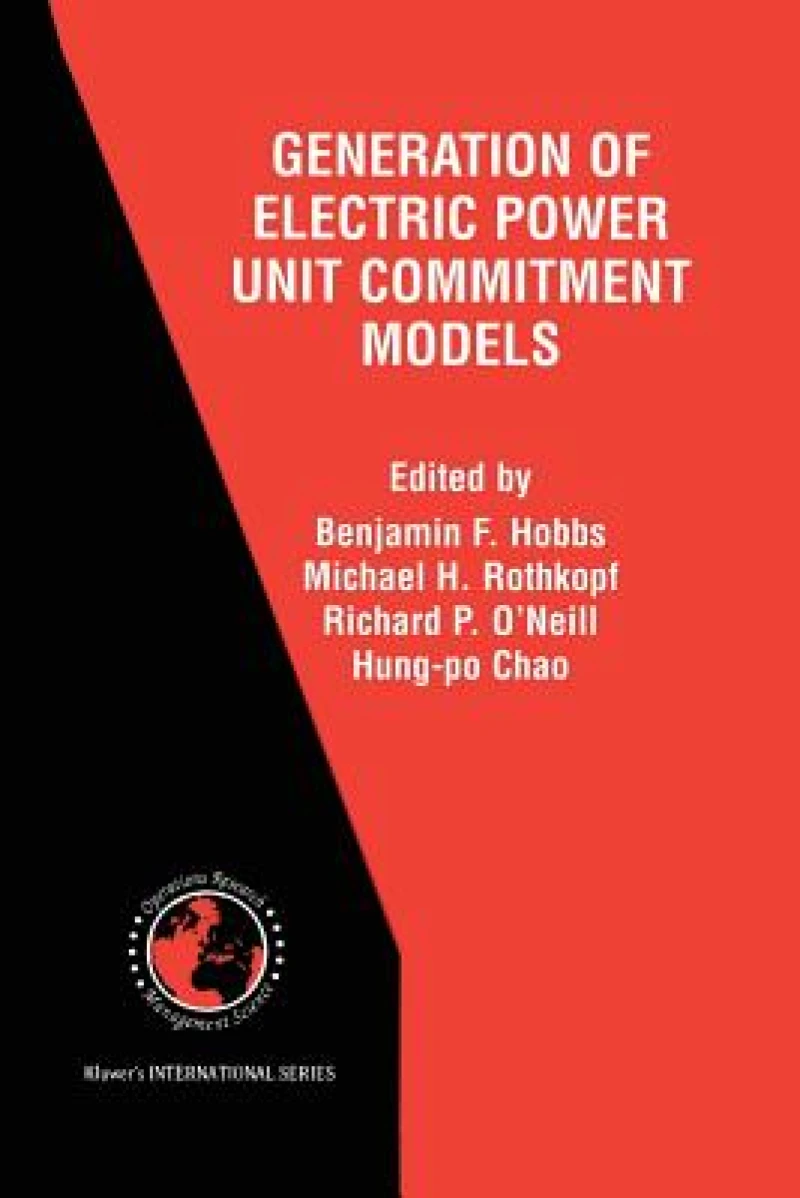
The Next Generation of Electric Power Unit Commitment Models
Softcover reprint of the original 1st ed. 2002
Book Details
Format
Paperback / Softback
ISBN-10
1475774168
ISBN-13
9781475774160
Edition
Softcover reprint of the original 1st ed. 2002
Publisher
Springer-Verlag New York Inc.
Imprint
Springer-Verlag New York Inc.
Country of Manufacture
US
Country of Publication
GB
Publication Date
Mar 17th, 2013
Print length
320 Pages
Ksh 36,000.00
Werezi Extended Catalogue
0 in stock
Delivery Location
Delivery fee: Select location
Secure
Quality
Fast
Over the years, the electric power industry has been using optimization methods to help them solve the unit commitment problem. The result has been savings of tens and perhaps hundreds of millions of dollars in fuel costs. Things are changing, however. Optimization technology is improving, and the industry is undergoing radical restructuring. Consequently, the role of commitment models is changing, and the value of the improved solutions that better algorithms might yield is increasing. The dual purpose of this book is to explore the technology and needs of the next generation of computer models for aiding unit commitment decisions.
Because of the unit commitment problem''s size and complexity and because of the large economic benefits that could result from its improved solution, considerable attention has been devoted to algorithm development in the book. More systematic procedures based on a variety of widely researched algorithms have been proposed and tested. These techniques have included dynamic programming, branch-and-bound mixed integer programming (MIP), linear and network programming approaches, and Benders decomposition methods, among others. Recently, metaheuristic methods have been tested, such as genetic programming and simulated annealing, along with expert systems and neural networks. Because electric markets are changing rapidly, how UC models are solved and what purposes they serve need reconsideration. Hence, the book brings together people who understand the problem and people who know what improvements in algorithms are really possible. The two-fold result in The Next Generation of Electric Power Unit Commitment Models is an assessment of industry needs and new formulations and computational approaches that promise to make unit commitment models more responsive to those needs.
Because of the unit commitment problem''s size and complexity and because of the large economic benefits that could result from its improved solution, considerable attention has been devoted to algorithm development in the book. More systematic procedures based on a variety of widely researched algorithms have been proposed and tested. These techniques have included dynamic programming, branch-and-bound mixed integer programming (MIP), linear and network programming approaches, and Benders decomposition methods, among others. Recently, metaheuristic methods have been tested, such as genetic programming and simulated annealing, along with expert systems and neural networks. Because electric markets are changing rapidly, how UC models are solved and what purposes they serve need reconsideration. Hence, the book brings together people who understand the problem and people who know what improvements in algorithms are really possible. The two-fold result in The Next Generation of Electric Power Unit Commitment Models is an assessment of industry needs and new formulations and computational approaches that promise to make unit commitment models more responsive to those needs.
Get The Next Generation of Electric Power Unit Commitment Models by at the best price and quality guaranteed only at Werezi Africa's largest book ecommerce store. The book was published by Springer-Verlag New York Inc. and it has pages.

