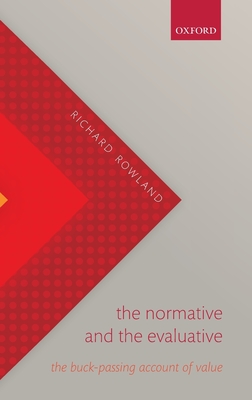
The Normative and the Evaluative : The Buck-Passing Account of Value
Book Details
Format
Hardback
ISBN-10
019883361X
ISBN-13
9780198833611
Publisher
Oxford University Press
Imprint
Oxford University Press
Country of Manufacture
GB
Country of Publication
GB
Publication Date
Feb 28th, 2019
Print length
256 Pages
Weight
514 grams
Dimensions
16.30 x 24.10 x 1.60 cms
Product Classification:
Philosophy: metaphysics & ontologyPhilosophy of mindEthics & moral philosophy
KSh 16,050.00
Currently unavailable
0 in stock
Delivery Location
Delivery fee: Select location
Secure
Quality
Fast
Rach Cosker- Rowland provides the first comprehensive motivation and defence of the buck-passing account of value: understanding the evaluative in terms of the normative. She argues that their account explains several important features of the relationship between reasons and value, as well as the relationship between the different varieties of value.
Many have been attracted to the idea that for something to be good there just have to be reasons to favour it. This view has come to be known as the buck-passing account of value. According to this account, for pleasure to be good there need to be reasons for us to desire and pursue it. Likewise for liberty and equality to be values there have to be reasons for us to promote and preserve them. Extensive discussion has focussed on some of the problems that the buck-passing account faces, such as the ''wrong kind of reason'' problem. Less attention, however, has been paid as to why we should accept the buck-passing account or what the theoretical pay-offs and other implications of accepting it are. The Normative and the Evaluative provides the first comprehensive motivation and defence of the buck-passing account of value. Rach Cosker-Rowland argues that the buck-passing account explains several important features of the relationship between reasons and value, as well as the relationship between the different varieties of value, in a way that its competitors do not. She shows that alternatives to the buck-passing account are inconsistent with important views in normative ethics, uninformative, and at odds with the way in which we should see practical and epistemic normativity as related. In addition, she extends the buck-passing account to provide an account of moral properties as well as all other normative and deontic properties and concepts, such as fittingness and ''ought'', in terms of reasons.
Get The Normative and the Evaluative by Rach Cosker-Rowland at the best price and quality guaranteed only at Werezi Africa's largest book ecommerce store. The book was published by Oxford University Press and it has 256 pages.
Customers Who Bought This Also Bought
Neville Goddard
KSh 5,850.00
Groundwork for the Metaphysics of Morals
KSh 2,000.00
The Sovereignty of Good
KSh 5,400.00
The Life Of The Mind
KSh 3,950.00
Groundwork for the Metaphysics of Morals – With an Updated Translation, Introduction, and Notes
KSh 1,950.00

De Anima (On the Soul)
KSh 2,350.00
Kant: The Metaphysics of Morals
KSh 5,300.00

Prolegomena to Any Future Metaphysics
KSh 2,700.00
An Inquiry Into Meaning and Truth
KSh 3,750.00
Hegel''s Inversion of Philosophy
KSh 17,100.00

Duns Scotus: Philosophical Writings
KSh 4,150.00

Metaphysics as a Guide to Morals
KSh 2,700.00