
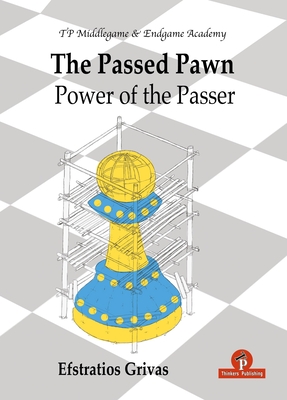
Book Details
Delivery Location
Delivery fee: Select location
Delivery in 12 days
The purpose of this series is to introduce the reader to advanced training concepts, using the same methods of presentation and instruction that were taught to great players by famous trainers that they have worked with. The series will commence with the The Passed Pawn and we will examine how to handle such pawns.
Most chess players focus more on the study of opening theory than other aspects of the game. The reasons are probably clear: opening theory is easier to learn and can provide immediate results, although this is based more on the opponent’s ignorance than our own abilities. Even for a chess trainer, it is easier to teach some variations from this or that opening or a set of simple tactical motifs than to engross himself in the exposition of middlegame and endgame theory. Yes, middlegame and endgame theory does exist. The great difficulty in approaching it lies in the fact that it does not follow absolute and clear-cut paths, but rather involves deep research in the ideas and logic by which specific types of positions are treated.
Moreover, unlike opening theory, the theory of the middlegame and the endgame does not change rapidly based on modern developments; it remains almost intact through the years. In view of the above, any chess player who wishes to follow a chess career or simply become a better player must refrain from the commonplace and assume a different approach. He must develop a good understanding of middlegame and endgame theory, so as to be able in his games to proceed in a proper way after his chosen opening has reached its conclusion. The chess player can differentiate himself only in the opening; there, each one of us brings forth his own beliefs and convictions, and in general his own experiences and references. Objectively, no opening loses — but also no opening wins. The opening is just the beginning of the journey and serves to offer us a comfortable start. But to reach the end of this journey successfully we have to count on our knowledge and experience, as regards middlegame and endgame theory.
Endgame theory teaches us two fundamental issues. First, how to extract the maximum from a basic theoretical position with little material, where the experts, from practice comprising thousands of games, have reached definite conclusions. Second, the way in which we can handle an endgame, depending on the material remaining on the board, and the ideas and plans we should employ. This second issue is significantly more difficult to master because, apart from making full use of the first one (we must be aware of the possible outcomes of the endgame in question) it is greatly influenced by our experience and understanding, which are basically derived from the images and impressions we have from related positions. A primary role is played here by the effort we have invested in studying. In middlegame theory, things are even tougher. We are obliged to study various types of positions with specific strategic and tactical attributes, so as to understand the underlying ideas and be able to employ them ourselves in similar situations. While many chess players have studied these topics and acquired knowledge, it is the application of this knowledge in practice that helps differentiate between them.
Chess is not a simple activity, but it becomes so much more attractive when we acquire this knowledge.
Get The Passed Pawn by Efstratios Grivas at the best price and quality guaranteed only at Werezi Africa's largest book ecommerce store. The book was published by Thinkers Publishing and it has 236 pages.
Customers Who Bought This Also Bought

The Royal Game: A Chess Story
KSh 1,450.00
Defense
KSh 1,800.00
Play the Catalan
KSh 3,050.00
222 Opening Traps
KSh 3,100.00
Grandmaster Repertoire 19 – Beating Minor Openings
KSh 4,700.00
Power Mates
KSh 3,950.00

In Black and White
KSh 5,750.00

Did You Come Here To Play Chess Or To Have Fun?
KSh 3,100.00

Playing the English – A World-Class Repertoire
KSh 4,850.00

Exploiting the Bishop Pair
KSh 3,600.00

Ding Liren''s Best Games
KSh 4,650.00

Chess Evolution 3
KSh 5,500.00
More by Efstratios Grivas
The Tactics Bible - Magnum Opus
KSh 5,050.00
The Modernized Grivas Sicilian
KSh 5,600.00
The Bishop Pair - Power of the Sun
KSh 4,700.00

Strategy
KSh 2,350.00
Bishop Endings
KSh 3,600.00
Practical Endgame Play - Mastering the Basics
KSh 3,050.00

Your Jungle Guide to Rook Endings
KSh 4,850.00
The Anti-Sicilian Bible
KSh 5,600.00
