
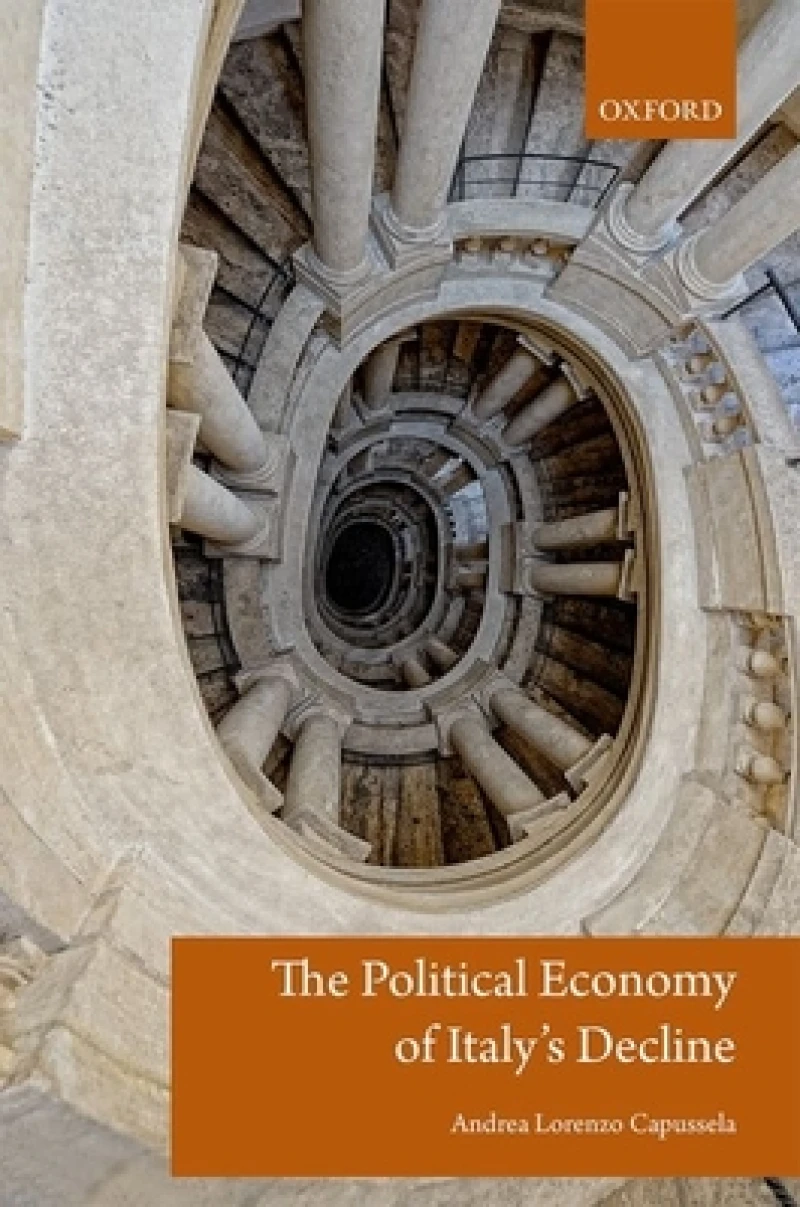
The Political Economy of Italy's Decline
Book Details
Format
Hardback or Cased Book
ISBN-10
0198796994
ISBN-13
9780198796992
Publisher
Oxford University Press
Imprint
Oxford University Press
Country of Manufacture
GB
Country of Publication
GB
Publication Date
Apr 19th, 2018
Print length
296 Pages
Weight
610 grams
Dimensions
16.60 x 24.00 x 2.70 cms
Product Classification:
Social & cultural historyPolitical structure & processesPolitical economyEconomic history
Ksh 20,900.00
Manufactured on Demand
0 in stock
Delivery Location
Delivery fee: Select location
Secure
Quality
Fast
Italy is a country of recent decline and long-standing idiosyncratic traits- a rich society where the rule of law is weak and political accountability is low. This book draws on political economic literature and historical analysis to argue that a battle of ideas can ease the shift to a fairer and more efficient equilibrium.
Italy is a country of recent decline and long-standing idiosyncratic traits. A rich society served by an advanced manufacturing economy, where the rule of law is weak and political accountability low, it has long been in downward spiral alimented by corruption and clientelism. From this spiral has emerged an equilibrium as consistent as it is inefficient, that raises serious obstacles to economic and democratic development. The Political Economy of Italy''s Decline explains the causes of Italy''s downward trajectory, and explains how the country can shift to a fairer and more efficient system. Analysing both political economic literature and the history of Italy from 1861 onwards, The Political Economy of Italy''s Decline argues that the deeper roots of the decline lie in the political economy of growth. It places emphasis on the country''s convergence to the productivity frontier and the evolution of its social order and institutions to illuminate the origins and evolution of the current constraints to growth, using institutional economics and Schumpeterian growth theory to support its findings. It analyses two alternative reactions to the insufficient provision of public goods: an opportunistic one – employing tax evasion, corruption, or clientelism as means to appropriate private goods –- and one based on enforcing political accountability. From the perspective of ordinary citizens and firms such social dilemmas can typically be modelled as coordination games, which have multiple equilibria. Self-interested rationality can thus lead to a spiral, in which several mutually reinforcing vicious circles lead society onto an inefficient equilibrium characterized by low political accountability and weak rule of law. The Political Economy of Italy''s Decline follows the gradual setting in of this spiral as it identifys the deeper causes of Italy''s decline.
Get The Political Economy of Italy's Decline by at the best price and quality guaranteed only at Werezi Africa's largest book ecommerce store. The book was published by Oxford University Press and it has pages.

