
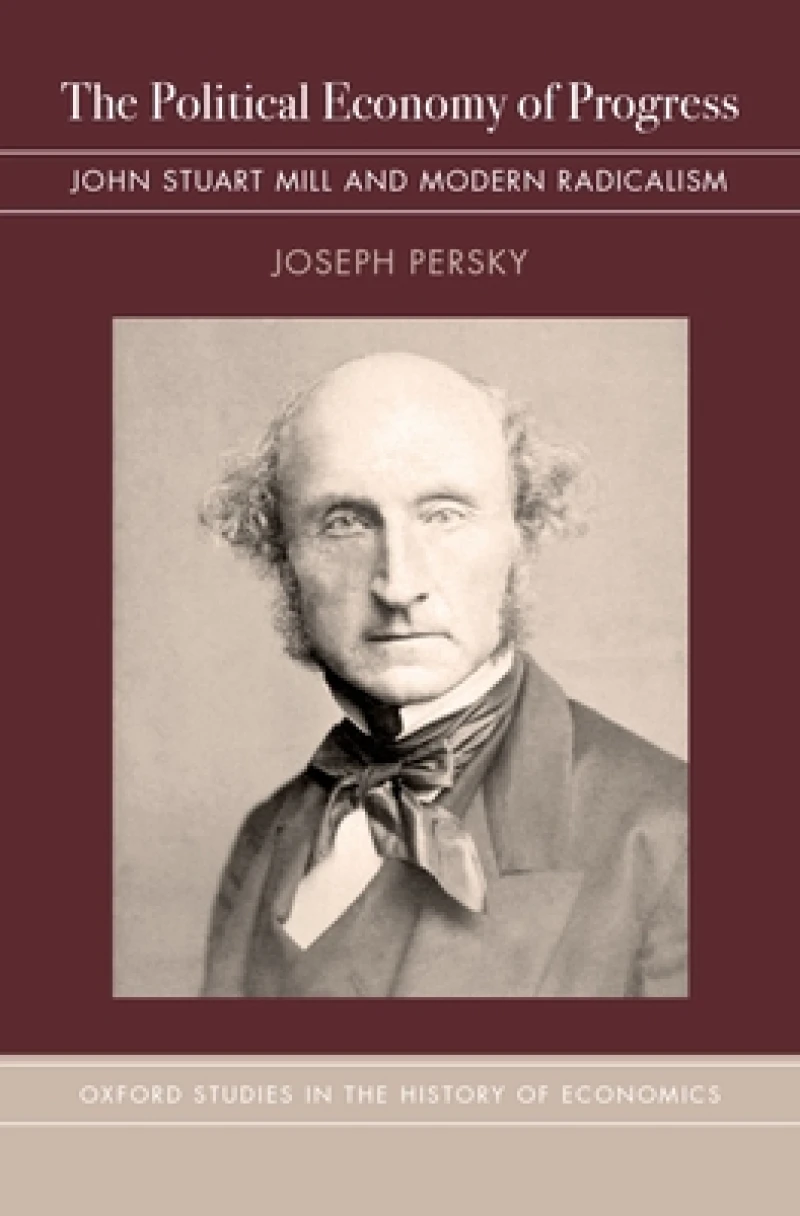
The Political Economy of Progress : John Stuart Mill and Modern Radicalism
Book Details
Format
Hardback or Cased Book
Book Series
Oxford Studies in History of Economics
ISBN-10
0190460636
ISBN-13
9780190460631
Publisher
Oxford University Press Inc
Imprint
Oxford University Press Inc
Country of Manufacture
US
Country of Publication
GB
Publication Date
Jul 7th, 2016
Print length
272 Pages
Weight
508 grams
Dimensions
24.40 x 16.70 x 2.80 cms
Ksh 19,800.00
Manufactured on Demand
0 in stock
Delivery Location
Delivery fee: Select location
Secure
Quality
Fast
John Stuart Mill constructed the first serious radical economics. Mill saw laissez-faire capitalism as a transitional system from which the working classes might emerge with decent wages, control of their workplaces, and a chance at meaningful individual development. Mill's understanding of progress became the very foundation of radical reform.
While there had been much radical thought before John Stuart Mill, Joseph Persky argues it was Mill, as he moved to the left, who provided the radical wing of liberalism with its first serious analytical foundation, a political economy of progress that still echoes today. A rereading of Mill''s mature work suggests his theoretical understanding of accumulation led him to see laissez-faire capitalism as a transitional system. Deeply committed to the egalitarian precepts of the Enlightenment, Mill advocated gradualism and rejected revolutionary expropriation on utilitarian grounds: gradualism, not expropriation, promised meaningful long-term gains for the working classes. He endorsed laissez-faire capitalism because his theory of accumulation saw that system approaching a stationary state characterized by a great reduction in inequality and an expansion of cooperative production. These tendencies, in combination with an aggressive reform agenda made possible by the extension of the franchise, promised to provide a material base for social progress and individual development.The Political Economy of Progress goes on to claim that Mill''s radical political economy anticipated more than a little of Marx''s analysis of capitalism and laid a foundation for the work of Fabians and other gradualist radicals in the 20th century. More recently, modern philosophic radicals, such as Rawls, have deep links to this Millean political economy. These links are still worthy of development. In particular, a politically meaningful acceptance of Rawls''s radical liberalism waits on a movement capable of re-engineering the workplace in a manner consistent with Mill''s endorsement of worker management.
Get The Political Economy of Progress by at the best price and quality guaranteed only at Werezi Africa's largest book ecommerce store. The book was published by Oxford University Press Inc and it has pages.

