
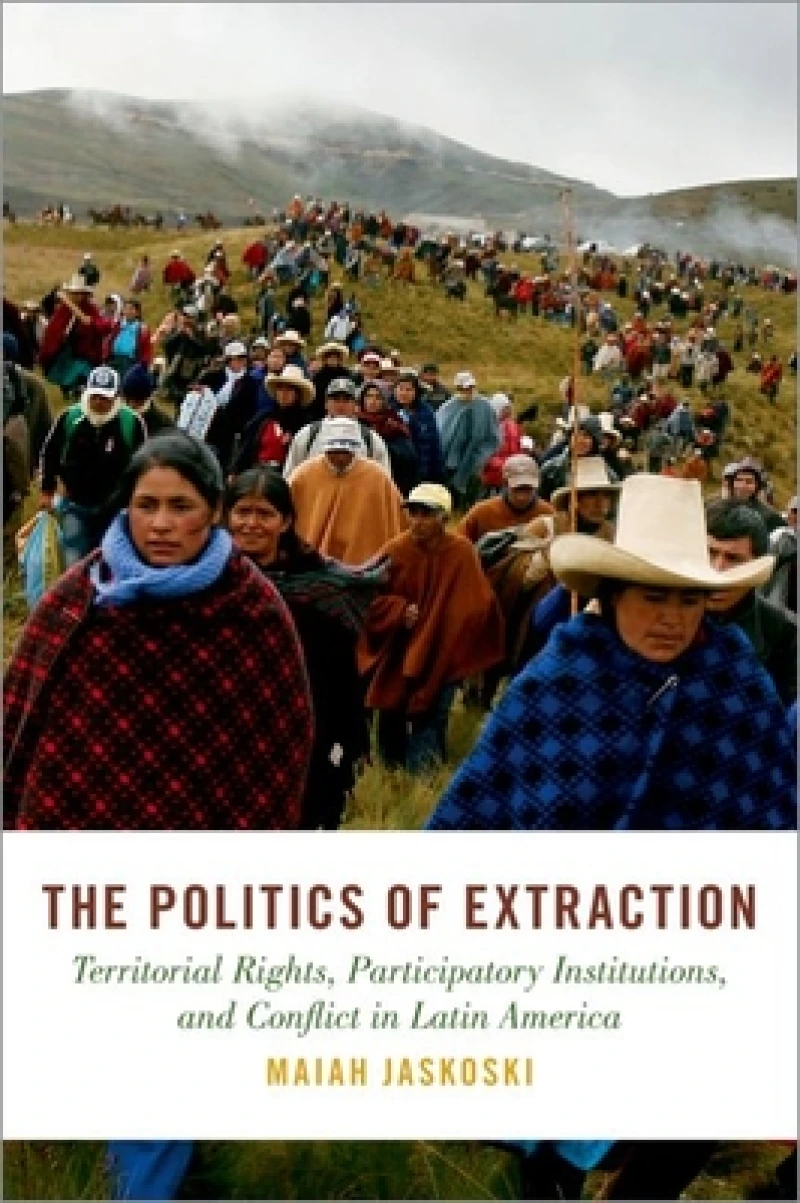
The Politics of Extraction : Territorial Rights, Participatory Institutions, and Conflict in Latin America
Book Details
Format
Hardback or Cased Book
Book Series
STUDIES COMPAR ENERGY ENVIRON POL SERIES
ISBN-10
0197568920
ISBN-13
9780197568927
Publisher
Oxford University Press Inc
Imprint
Oxford University Press Inc
Country of Manufacture
GB
Country of Publication
GB
Publication Date
Oct 14th, 2022
Print length
296 Pages
Weight
572 grams
Dimensions
16.30 x 24.30 x 2.50 cms
Product Classification:
Development studiesUnited Nations & UN agenciesEnvironmental policy & protocols
Ksh 15,350.00
Werezi Extended Catalogue
0 in stock
Delivery Location
Delivery fee: Select location
Secure
Quality
Fast
In The Politics of Extraction, Maiah Jaskoski looks at how mobilized communities in Latin America''s hydrocarbon and mining regions use participatory institutions to challenge extraction. In some cases, communities act within formal participatory spaces, while in others, they organize "around" or "in reaction to" these institutions, using participatory procedures as focal points in the escalation of conflict. Based on analysis of thirty major extractive conflicts in Bolivia, Colombia, and Peru in the 2000s and 2010s, Jaskoski provides the first systematic study of how participatory institutions either channel or exacerbate conflict over extraction.
Mining and hydrocarbon production in Latin America is high-stakes for extractive firms, communities in resource-rich zones, and states. Amid global commodity price increases and liberal economic policies, the sectors have expanded dramatically in recent decades. This surge has made private investors and governments in the region ever more committed to extraction. It also has increased alarm within local communities, which have organized around the environmental, cultural, and social impacts of mining and hydrocarbons. Moreover, activists have mobilized to demand material benefits, in the forms of royalty distributions and direct company investment in local services and infrastructure. These conflicts take the form of legal battles, large-scale protests, and standoffs that pit communities against companies and the state, and consequently have suspended production, destabilized politics, and expended state security resources. In The Politics of Extraction, Maiah Jaskoski looks at how mobilized communities in Latin America''s hydrocarbon and mining regions use participatory institutions to challenge extraction. In some cases, communities act within formal participatory spaces, while in others, they organize "around" or "in reaction to" these institutions, using participatory procedures as focal points in the escalation of conflict. Based on analysis of thirty major extractive conflicts in Bolivia, Colombia, and Peru in the 2000s and 2010s, Jaskoski examines community uses of public hearings built into environmental licensing, state-led prior consultation with native communities affected by large-scale development, and local popular consultations or referenda. She finds that communities select their strategies in response to the specific participatory challenges they confront: the trials of initiating participatory processes, gaining inclusion in participatory events, and, for communities with such access, expressing views about extraction at the participatory stage. Surprisingly, the communities least likely to channel their concerns through state institutions are the most unified and have the strongest guarantee of participation. Including a wealth of data and complex stories, Jaskoski provides the first systematic study of how participatory institutions either channel or exacerbate conflict over extraction.
Get The Politics of Extraction by at the best price and quality guaranteed only at Werezi Africa's largest book ecommerce store. The book was published by Oxford University Press Inc and it has pages.

