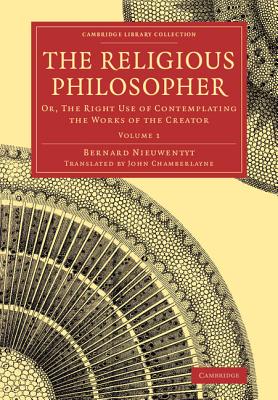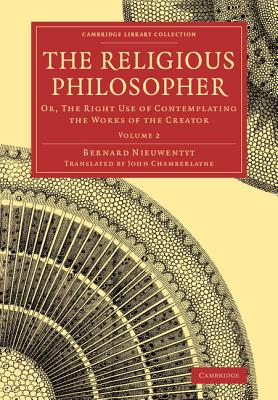
The Religious Philosopher - Volume 2 : Or, The Right Use of Contemplating the Works of the Creator
Book Details
Format
Paperback / softback
ISBN-10
1108078192
ISBN-13
9781108078191
Publisher
Cambridge University Press
Imprint
Cambridge University Press
Country of Manufacture
GB
Country of Publication
GB
Publication Date
Nov 13th, 2014
Print length
390 Pages
Weight
660 grams
Dimensions
24.50 x 17.00 x 2.00 cms
Product Classification:
Philosophy of religionHistory of ideasHistory of ideasPhilosophy of religion
KSh 6,800.00
Currently unavailable
0 in stock
Delivery Location
Delivery fee: Select location
Secure
Quality
Fast
Originally published in Dutch in 1715, and reissued here in its 1724 English translation, this two-volume work by the philosopher and theologian Bernard Nieuwentyt (1654–1718) argues that the scientific examination of the natural world is compatible with religious belief. The book notably influenced the natural theology of William Paley.
Originally published in Dutch in 1715, this two-volume work by the philosopher and theologian Bernard Nieuwentyt (1654–1718) is reissued here in the 1724 third edition of the English translation by John Chamberlayne (1668/9–1723). The book seeks to persuade both Christians and atheists that scientific examination of the natural world is compatible with religious belief. According to Chamberlayne, Nieuwentyt published this illustrated work to 'magnify the Wisdom and Goodness of God' while challenging those who did not see proof of the divine in nature. The work is known to have influenced the natural theology of the English philosopher William Paley (1743–1805), whose famous analogy of the watchmaker is believed to have been taken directly from Nieuwentyt. Arguing against rationalist philosophers such as Spinoza, Volume 2 continues Nieuwentyt's series of 'contemplations', focusing on details about the cosmos and the laws of nature.
Get The Religious Philosopher - Volume 2 by Bernard Nieuwentyt at the best price and quality guaranteed only at Werezi Africa's largest book ecommerce store. The book was published by Cambridge University Press and it has 390 pages.
Customers Who Bought This Also Bought
Beyond Good and Evil
KSh 2,000.00

We Who Wrestle With God
KSh 3,600.00

Satan
KSh 2,150.00

Great Ideas Fear and Trembling
KSh 1,450.00
Pilgrims Regress
KSh 2,000.00
Critique of Judgement
KSh 2,700.00

The Resurrection of the Son of God
KSh 10,800.00

Religion within the Bounds of Bare Reason
KSh 3,450.00
What I Believe
KSh 2,900.00
C. S. Lewis on the Soul, God, and Christianity
KSh 3,050.00
Supreme Gift
KSh 2,700.00
Sickness unto Death
KSh 2,000.00