
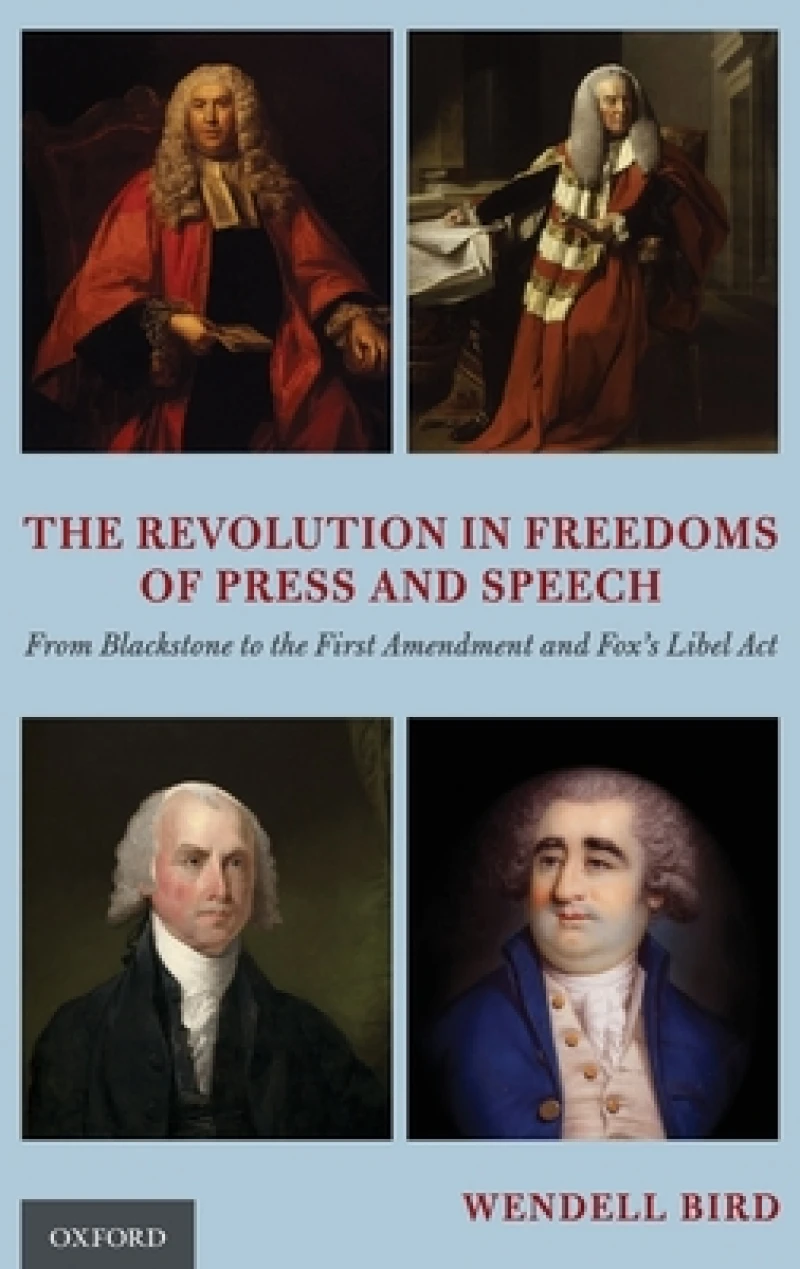
The Revolution in Freedoms of Press and Speech : From Blackstone to the First Amendment and Fox's Libel Act
by
Wendell Bird
Book Details
Format
Hardback or Cased Book
ISBN-10
0197509193
ISBN-13
9780197509197
Publisher
Oxford University Press Inc
Imprint
Oxford University Press Inc
Country of Manufacture
US
Country of Publication
GB
Publication Date
Apr 22nd, 2020
Print length
408 Pages
Weight
703 grams
Dimensions
16.00 x 23.90 x 3.60 cms
Product Classification:
Law & societyLegal history
Ksh 22,350.00
Werezi Extended Catalogue
0 in stock
Delivery Location
Delivery fee: Select location
Secure
Quality
Fast
This book discusses the revolutionary broadening of concepts of freedom of press and freedom of speech in Great Britain and in America in the late eighteenth century, in the period that produced state declarations of rights and then the First Amendment and Fox's Libel Act.
This book discusses the revolutionary broadening of concepts of freedom of press and freedom of speech in Great Britain and in America in the late eighteenth century, in the period that produced state declarations of rights and then the First Amendment and Fox''s Libel Act.The conventional view of the history of freedoms of press and speech is that the common law since antiquity defined those freedoms narrowly, and that Sir William Blackstone in 1769, and Lord Chief Justice Mansfield in 1770, faithfully summarized the common law in giving a very narrow definition of those freedoms as mere liberty from prior restraint and not liberty from punishment after something was printed or spoken.This book proposes, to the contrary, that Blackstone carefully selected the narrowest definition that had been suggested in popular essays in the prior seventy years, in order to oppose the growing claims for much broader protections of press and speech. Blackstone misdescribed his summary as an accepted common law definition, which in fact did not exist. A year later, Mansfield inserted a similar definition into the common law for the first time, also misdescribing it as a long-accepted definition, and soon misdescribed the unique rules for prosecuting sedition as having an equally ancient pedigree. Blackstone and Mansfield were not declaring the law as it had long been, but were leading a counter-revolution about the breadth of freedoms of press and speech, and cloaking it as a summary of a narrow common law doctrine that in fact was nonexistent.That conflict of revolutionary view and counter-revolutionary view continues today. For over a century, a neo-Blackstonian view has been dominant, or at least very influential, among historians. Contrary to those narrow claims, this book concludes that the broad understanding of freedoms of press and speech was the dominant context of the First Amendment and of Fox''s Libel Act, and that it enjoyed greater historical support.
Get The Revolution in Freedoms of Press and Speech by at the best price and quality guaranteed only at Werezi Africa's largest book ecommerce store. The book was published by Oxford University Press Inc and it has pages.

