
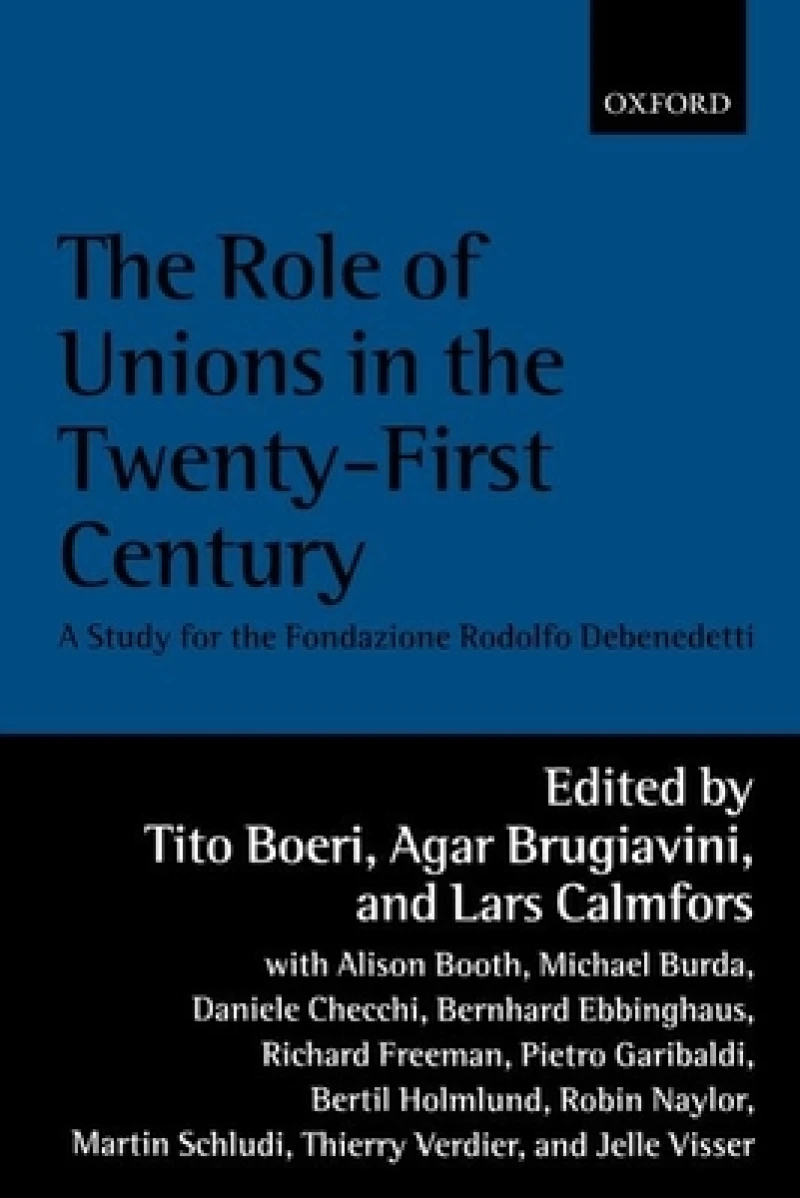
The Role of Unions in the Twenty-first Century : A Report for the Fondazione Rodolfo Debenedetti
Book Details
Format
Paperback / Softback
ISBN-10
0199246580
ISBN-13
9780199246588
Publisher
Oxford University Press
Imprint
Oxford University Press
Country of Manufacture
GB
Country of Publication
GB
Publication Date
Aug 16th, 2001
Print length
320 Pages
Weight
488 grams
Dimensions
23.40 x 15.90 x 2.00 cms
Product Classification:
Labour economicsTrade unions
Ksh 14,950.00
Manufactured on Demand
0 in stock
Delivery Location
Delivery fee: Select location
Secure
Quality
Fast
In this book, scholars in the field explore the role that unions are likely to play in the changed economic environment of the new century.
In this book, first-rate international scholars in the field explore the role that unions are likely to play in the changed economic environment of the new century. Questions discussed include: What will unions look like in the years to come? Which kind of interest groups will they represent? How important will be the broader political role of unions? To what extent do unions care about future generations? Part One documents a tendency towards greater decentralization in collective bargaining and declining union membership rates in most European countries. The process of decentralization may only be partly reversed by social pacts of the type that occurred in several EU countries in the run-up to EMU. Yet this type of co-ordination is likely to be increasingly unstable in a context where membership is falling, hence will inevitably require government intervention. Not all governments may wish to intervene in wage setting, however, as there are strong reasons to believe that such intervention could impose wage rigidities in some parts of the economy and lead to non-enforcement in other parts. Moreover, under EMU what matters is ultimately co-ordination of bargaining at the pan-European level rather than simply at the national level. Such higher-level, transnational co-ordination is not likely to occur for a long time to come because of the huge costs that it involves. Some transnational co-ordination may occur within multinational firms, however, as costs are likely to be much lower at this level. Part Two characterizes the intergenerational conflicts present within unions. Unions may be able to better respond to the needs of the unemployed without losing the support of current employees when they become involved in the running of unemployment benefit systems, as has been the case in those countries applying the so-called Ghent system. They may also succeed in making the system more efficient by, for example, contributing to the reduction of moral hazard problems associated with the provision of unemployment insurance. Unions are, however, unlikely to solve the latent conflict between their younger and older members in a context where the population is ageing, since they tend to preserve the status quo when it comes to cutting pension benefits in order to deal with demographic transition. The cost of these dynamic inefficiencies may be accepted by younger generations as long as an intergenerational contract can be enforced whereby unions guarantee that the status quo will be preserved, and are credible in their commitment. Unions could play a key role in this implicit intergenerational pact because they are long-lived agents---certainly longer-lived than many governments---but, under present conditions, this pact may be no longer credible.
Get The Role of Unions in the Twenty-first Century by at the best price and quality guaranteed only at Werezi Africa's largest book ecommerce store. The book was published by Oxford University Press and it has pages.

