
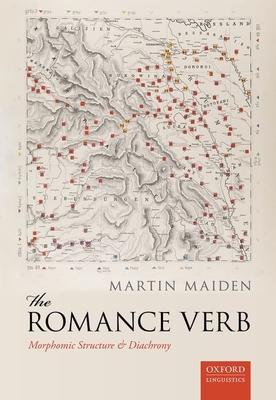
The Romance Verb : Morphomic Structure and Diachrony
Book Details
Format
Hardback
ISBN-10
0199660212
ISBN-13
9780199660216
Publisher
Oxford University Press
Imprint
Oxford University Press
Country of Manufacture
GB
Country of Publication
GB
Publication Date
Mar 29th, 2018
Print length
372 Pages
Weight
826 grams
Dimensions
25.20 x 18.00 x 2.90 cms
Product Classification:
Historical & comparative linguisticsGrammar, syntax & morphology
KSh 21,700.00
Temporarily out of stock, due soon
0 in stock
Delivery Location
Delivery fee: Select location
Secure
Quality
Fast
This book is the first comprehensive comparative-historical survey of patterns of alternation in the Romance verb that persist through time but have long ceased to be conditioned by any phonological or functional determinant. It explores the status of these patterns and their persistence, self-replication, and reinforcement over time.
This book is the first comprehensive comparative-historical survey of patterns of alternation in the Romance verb which appear to be ''autonomously morphological'': although they can be shown to be persistent through time, they have long ceased to be conditioned by any phonological or functional determinant. Some of these patterns are well known in Romance linguistics, while others have scarcely been noticed. The sheer range of phenomena which participate in these patterns in any case far surpasses what Romance linguists had previously realized. The patterns constitute a kind of abstract ''leitmotiv'', running through the history of the Romance languages and conferring on them a distinctive morphological physiognomy. Although intended primarily as a novel contribution to comparative-historical Romance linguistics, the book considers in detail the status of these patterns which appear to be a matter of ''morphology by itself'', unsupported by determining factors external to the morphological system. Particular attention is paid to the problem of their persistence, self-replication, and reinforcement over time. Why do abstract morphological patterns that quite literally ''do not make sense'' display such diachronic robustness? The evidence suggests that speakers, faced with different ways of expressing semantically identical material, seek out distributional templates into which those differences can be deployed. In Romance the only available templates happen to be ''morphomic'', morphologically accidental, effects of old sound changes or defunct functional conditionings. Those patterns are accordingly exploited, and indeed reinforced, by being made maximally predictable.
Get The Romance Verb by Martin Maiden at the best price and quality guaranteed only at Werezi Africa's largest book ecommerce store. The book was published by Oxford University Press and it has 372 pages.
Customers Who Bought This Also Bought

Adventure Of English
KSh 2,350.00

Naming of the Shrew
KSh 2,000.00
The Names of Science
KSh 7,850.00

A Grammar of Teotitlan del Valle Zapotec
KSh 28,100.00

Romania Africana
KSh 32,750.00
You All Spoken Here
KSh 4,950.00

A Comparative Analysis of Classifier-Noun Structures in Chinese and English
KSh 32,000.00
Indo-Scythian Studies, Volume VI
KSh 9,750.00

African Englishes and Multilingualism for the Transformative Development of Postcolonial Africa
KSh 6,100.00
Morphologische Untersuchungen Auf Dem Gebiete Der Indogermanischen Sprachen
KSh 7,200.00
Interactions across Englishes
KSh 18,700.00
Semantic Interpretation and the Resolution of Ambiguity
KSh 7,600.00
More by Martin Maiden

The Language of Practical Mathematics in Renaissance Italy
KSh 30,950.00

A Reference Grammar of Modern Italian
KSh 6,300.00

A Reference Grammar of Modern Italian
KSh 17,100.00
A Linguistic History of Italian
KSh 11,350.00
Interactive Morphonology
KSh 7,650.00
A Reference Grammar of Modern Italian
KSh 9,300.00
Interactive Morphonology
KSh 28,050.00
Linguistic History of Italian, A
KSh 35,650.00
A Reference Grammar of Modern Italian
KSh 32,700.00
The Oxford History of Romanian Morphology
KSh 24,900.00
