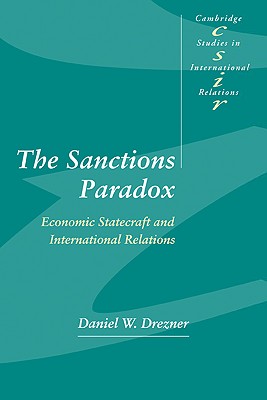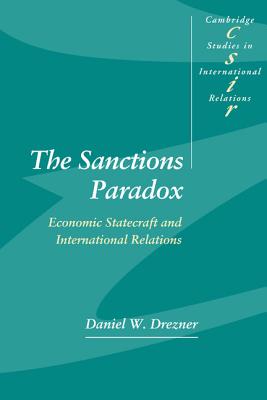
The Sanctions Paradox : Economic Statecraft and International Relations
Book Details
Format
Hardback
Book Series
Cambridge Studies in International Relations
ISBN-10
0521643325
ISBN-13
9780521643320
Publisher
Cambridge University Press
Imprint
Cambridge University Press
Country of Manufacture
GB
Country of Publication
GB
Publication Date
Aug 26th, 1999
Print length
364 Pages
Weight
69 grams
Dimensions
22.90 x 15.20 x 2.10 cms
Product Classification:
International relations
KSh 19,800.00
Currently unavailable
0 in stock
Delivery Location
Delivery fee: Select location
Secure
Quality
Fast
The conventional wisdom is that economic sanctions do not work in international affairs. If so, why do countries wield them so often? This 1999 book argues that, paradoxically, countries are most likely to be willing to use sanctions under conditions where they will produce the feeblest results.
Despite their increasing importance, there is little theoretical understanding of why nation-states initiate economic sanctions, or what determines their success. This 1999 book argues that both imposers and targets of economic coercion incorporate expectations of future conflict as well as the short-run opportunity costs of coercion into their behaviour. Drezner argues that conflict expectations have a paradoxical effect. Adversaries will impose sanctions frequently, but rarely secure concessions. Allies will be reluctant to use coercion, but once sanctions are used, they can result in significant concessions. Ironically, the most favourable distribution of payoffs is likely to result when the imposer cares the least about its reputation or the distribution of gains. The book's argument is pursued using game theory and statistical analysis, and detailed case studies of Russia's relations with newly-independent states, and US efforts to halt nuclear proliferation on the Korean peninsula.
Get The Sanctions Paradox by Daniel W. Drezner at the best price and quality guaranteed only at Werezi Africa's largest book ecommerce store. The book was published by Cambridge University Press and it has 364 pages.
Customers Who Bought This Also Bought

Black Wave
KSh 2,700.00

Siege
KSh 2,000.00

Extractive Capitalism
KSh 2,150.00
Strategy
KSh 4,350.00

Fourth Industrial Revolution
KSh 2,700.00

On China
KSh 3,400.00

Dead Aid
KSh 3,400.00
The Bottom Billion
KSh 2,500.00

Leadership
KSh 2,700.00
How to Win a Trade War
KSh 3,050.00

Understanding Global Conflict and Cooperation: An Introduction to Theory and History
KSh 14,000.00

Nuclear Age
KSh 5,400.00