
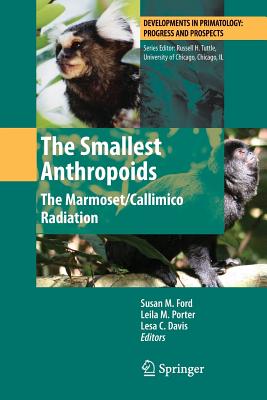
The Smallest Anthropoids : The Marmoset/Callimico Radiation
2009 ed.
Book Details
Format
Paperback / softback
ISBN-10
1461424461
ISBN-13
9781461424468
Edition
2009 ed.
Publisher
Springer-Verlag New York Inc.
Imprint
Springer-Verlag New York Inc.
Country of Manufacture
US
Country of Publication
GB
Publication Date
Feb 25th, 2012
Print length
508 Pages
Weight
778 grams
Dimensions
15.60 x 23.30 x 2.90 cms
KSh 36,000.00
Werezi Extended Catalogue
Delivery in 12 days
1 copies in stock
Delivery Location
Delivery fee: Select location
Delivery in 12 days
Secure
Quality
Fast
Here is a comprehensive examination of the newly recognized callimico/marmoset clade, which includes the smallest anthropoid primates on earth. It features sections on phylogeny, taxonomy and functional anatomy, behavioral ecology, and reproductive physiology.
The marmosets and callimicos are diminutive monkeys from the Amazon basin and Atlantic Coastal Forest of South America. The marmosets are the smallest anthropoid primates in the world, ranging in size from approximately 100 to 350 g (Hershkovitz 1977; Soini 1988; Ford and Davis 1992; Araujo et al. 2000); calli- cos are not much bigger, at around 350-540 g (Ford and Davis 1992; Encarnacion and Heymann 1998; Garber and Leigh 2001). Overwhelming genetic evidence, from both nuclear and mitochondrial DNA, now indicates that these taxa represent a unified clade within the callitrichid radiation of New World monkeys, a finding that was unthinkable to all but a few geneticists a decade ago (see review in Cortes- Ortiz, this volume Chap. 2). With increasing evidence that the earliest anthropoids were themselves small bodied (under the 0. 8-1 kg threshold that marks all other living anthropoids; see Ross and Kay 2004), the ecology, behavior, reproductive stresses, and anatomical adaptations of the marmosets and callimicos provide the best living models with which to assess the types of adaptations that may have characterized early anthropoids. When Anthony Rylands' Marmosets and Tamarins: Systematics, Behaviour and Ecology was published in 1993, contributions focused almost entirely on tamarins due to the scarcity of data on marmoset behavior and the almost total lack of kno- edge about the enigmatic callimicos. Fortunately, this has changed (see Fig. 1).
Get The Smallest Anthropoids by Leila M. Porter at the best price and quality guaranteed only at Werezi Africa's largest book ecommerce store. The book was published by Springer-Verlag New York Inc. and it has 508 pages.
Customers Who Bought This Also Bought

Culture and Imperialism
KSh 2,700.00

Curfew
KSh 7,950.00

The Invention of Yesterday
KSh 5,400.00

Ruin of Kasch
KSh 2,350.00

Exercised
KSh 2,700.00

Structural Anthropology
KSh 3,950.00

The Botany of Desire
KSh 2,700.00

Sapiens A Graphic History, Volume 2
KSh 4,300.00

Sapiens A Graphic History, Volume 1
KSh 4,600.00

Game Without Frontiers
KSh 11,150.00

Rainforest Warriors
KSh 4,300.00

Causes and Consequences of Human Migration
KSh 18,200.00