
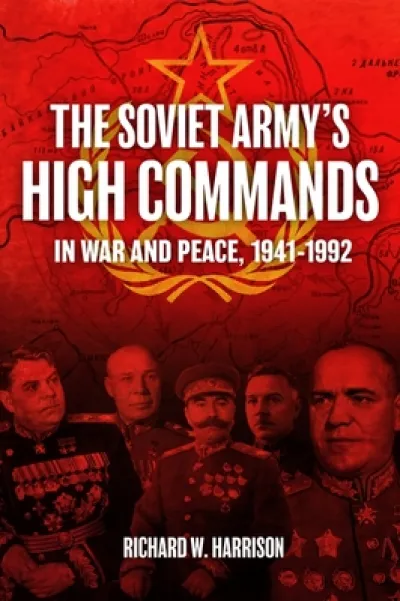
The Soviet Army's High Commands in War and Peace, 1941-1992
Book Details
Format
Hardback or Cased Book
ISBN-10
1952715105
ISBN-13
9781952715105
Publisher
Casemate Publishers
Imprint
Casemate Publishers
Country of Manufacture
US
Country of Publication
GB
Publication Date
Jun 15th, 2022
Print length
480 Pages
Weight
920 grams
Dimensions
16.10 x 23.90 x 3.30 cms
Ksh 7,000.00
Temporarily out of stock, due soon
0 in stock
Delivery Location
Delivery fee: Select location
Secure
Quality
Fast
The war on the Eastern Front during 1941-45 was an immense struggle, running from the Barents Sea to the Caucasus Mountains. The vast distances involved forced the Soviet political-military leadership to resort to new organizational expedients in order to control operations along the extended front. These were the high commands of the directions, which were responsible for two or more fronts (army groups) and, along maritime axes, one or more fleets. In all, five high commands were created along the northwestern, western, southwestern, and North Caucasus strategic directions during 1941-42. However, the highly unfavourable strategic situation during the first year of the war, as well as interference in day-to-day operations by Stalin, severely limited the high commands'' effectiveness. As a consequence, the high commands were abolished in mid-1942 and replaced by the more flexible system of supreme command representatives at the front. A High Command of Soviet Forces in the Far East was established in 1945 and oversaw the Red Army''s highly effective campaign against Japanese forces in Manchuria. The Far Eastern High Command was briefly resurrected in 1947 as a response to the tense situation along the Korean peninsula and the ongoing civil war in China, but was abolished in 1953, soon after Stalin''s death. Growing tensions with China brought about the recreation of the Far Eastern High Command in 1979, followed a few years later by the appearance of new high commands in Europe and South Asia. However, these new high commands did not long survive the collapse of the Soviet Union in 1991 and were abolished a year later. The book relies almost exclusively on Soviet and post-communist archival and other sources and is the first unclassified treatment of this subject in any country, East or West.
The war on the Eastern Front during 1941-45 was an immense struggle, running from the Barents Sea to the Caucasus Mountains. The vast distances involved forced the Soviet political-military leadership to resort to new organizational expedients in order to control operations along the extended front. These were the high commands of the directions, which were responsible for two or more fronts (army groups) and, along maritime axes, one or more fleets. In all, five high commands were created along the northwestern, western, southwestern, and North Caucasus strategic directions during 1941-42. However, the highly unfavourable strategic situation during the first year of the war, as well as interference in day-to-day operations by Stalin, severely limited the high commands' effectiveness. As a consequence, the high commands were abolished in mid-1942 and replaced by the more flexible system of supreme command representatives at the front. A High Command of Soviet Forces in the Far East was established in 1945 and oversaw the Red Army's highly effective campaign against Japanese forces in Manchuria. The Far Eastern High Command was briefly resurrected in 1947 as a response to the tense situation along the Korean peninsula and the ongoing civil war in China, but was abolished in 1953, soon after Stalin's death. Growing tensions with China brought about the recreation of the Far Eastern High Command in 1979, followed a few years later by the appearance of new high commands in Europe and South Asia. However, these new high commands did not long survive the collapse of the Soviet Union in 1991 and were abolished a year later. The book relies almost exclusively on Soviet and post-communist archival and other sources and is the first unclassified treatment of this subject in any country, East or West.
Get The Soviet Army's High Commands in War and Peace, 1941-1992 by at the best price and quality guaranteed only at Werezi Africa's largest book ecommerce store. The book was published by Casemate Publishers and it has pages.

