
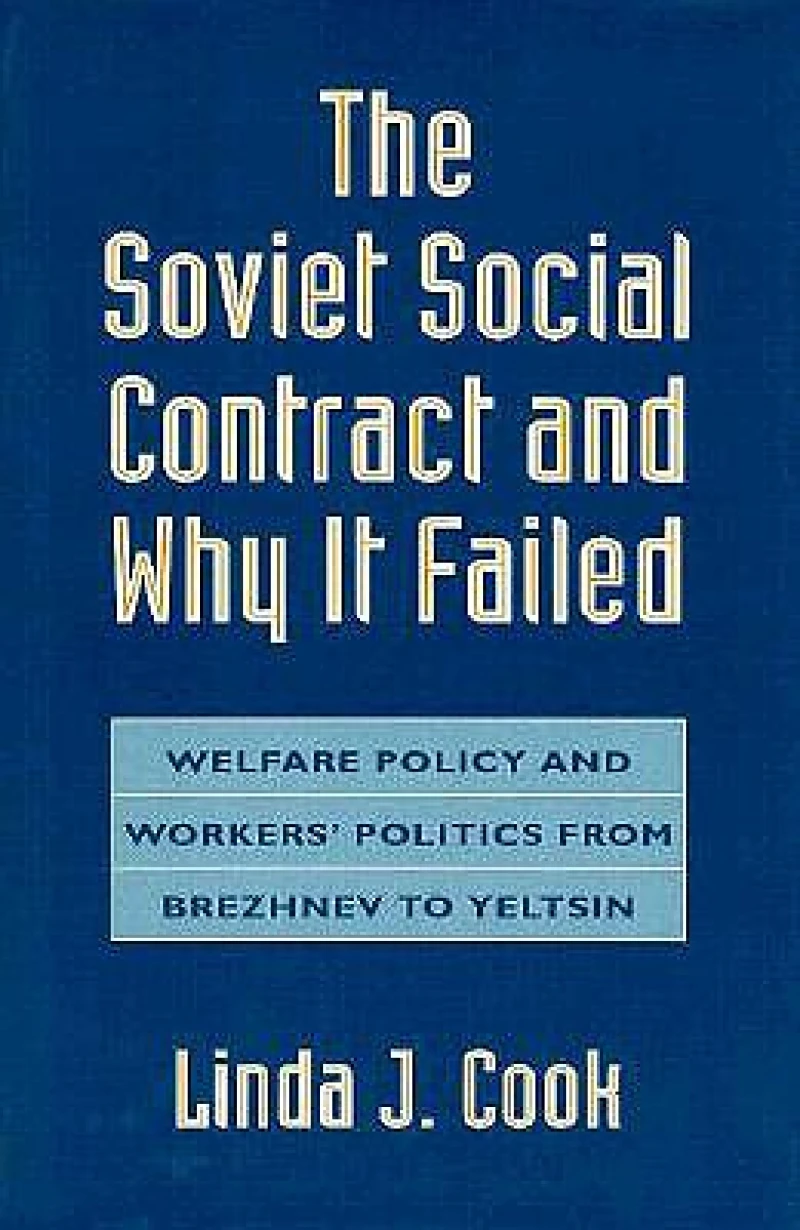
The Soviet Social Contract & Why it Failed – Welfare Policy & Worker's Politics from Brezhnev to Yeltsin : Welfare Policy and Workers’ Politics from Brezhnev to Yeltsin
Book Details
Format
Hardback or Cased Book
Book Series
Russian Research Center Studies
ISBN-10
0674828003
ISBN-13
9780674828001
Publisher
Harvard University Press
Imprint
Harvard University Press
Country of Manufacture
US
Country of Publication
GB
Publication Date
Jan 1st, 1993
Print length
272 Pages
Weight
642 grams
Dimensions
16.70 x 24.30 x 2.70 cms
Ksh 15,100.00
Temporarily out of stock, due soon
0 in stock
Delivery Location
Delivery fee: Select location
Secure
Quality
Fast
A critical assessment of the implications of the "social contract" - a tacit agreement between the post-Stalin regime and the working class whereby the state provided economic and social security in return for the workers' political compliance.
As their woefully backward economy continues to crumble, much of the Soviet population remains indifferent, if not downright hostile, to the idea of reform. This phenomenon, so different from the Solidarity movement in Poland or the velvet revolution in Czechoslovakia, has been explained in terms of a “social contract”—a tacit agreement between the post-Stalin regime and the working class whereby the state provided economic and social security in return for the workers' political compliance. This book is the first critical assessment of the likelihood and implications of such a contract. Linda Cook pursues the idea from Brezhnev's day to our own, and considers the constraining effect it may have had on Gorbachev's attempts to liberalize the Soviet economy. In case studies on job security, retail price stability, and social service subsidies, Cook identifies points at which leaders had to make critical decisions—to commit more resources or to abandon other policies at significant cost—in order to maintain the contract. The pattern that emerges attests to the validity of the social contract thesis for the Brezhnev period. At the same time, Cook's analysis points to several important factors, such as the uneven distribution of benefits, that help explain why labor unrest and activism have varied dramatically from sector to sector in recent years. Ultimately, these case studies reveal, particularly for the Gorbachev period, deep conflicts between the old contract and the requisites of economic reform. Cook extends her analysis into the Yeltsin period to show how the democratizing state dealt weakly with labor's demands, seeking to stabilize labor relations with an inappropriate corporate structure. In the end, mobilized labor contributed greatly to the pressures that undermined Gorbachev's regime, and remained an obstacle to economic reform through the early months of Yeltsin's Russia.
Get The Soviet Social Contract & Why it Failed – Welfare Policy & Worker's Politics from Brezhnev to Yeltsin by at the best price and quality guaranteed only at Werezi Africa's largest book ecommerce store. The book was published by Harvard University Press and it has pages.

