
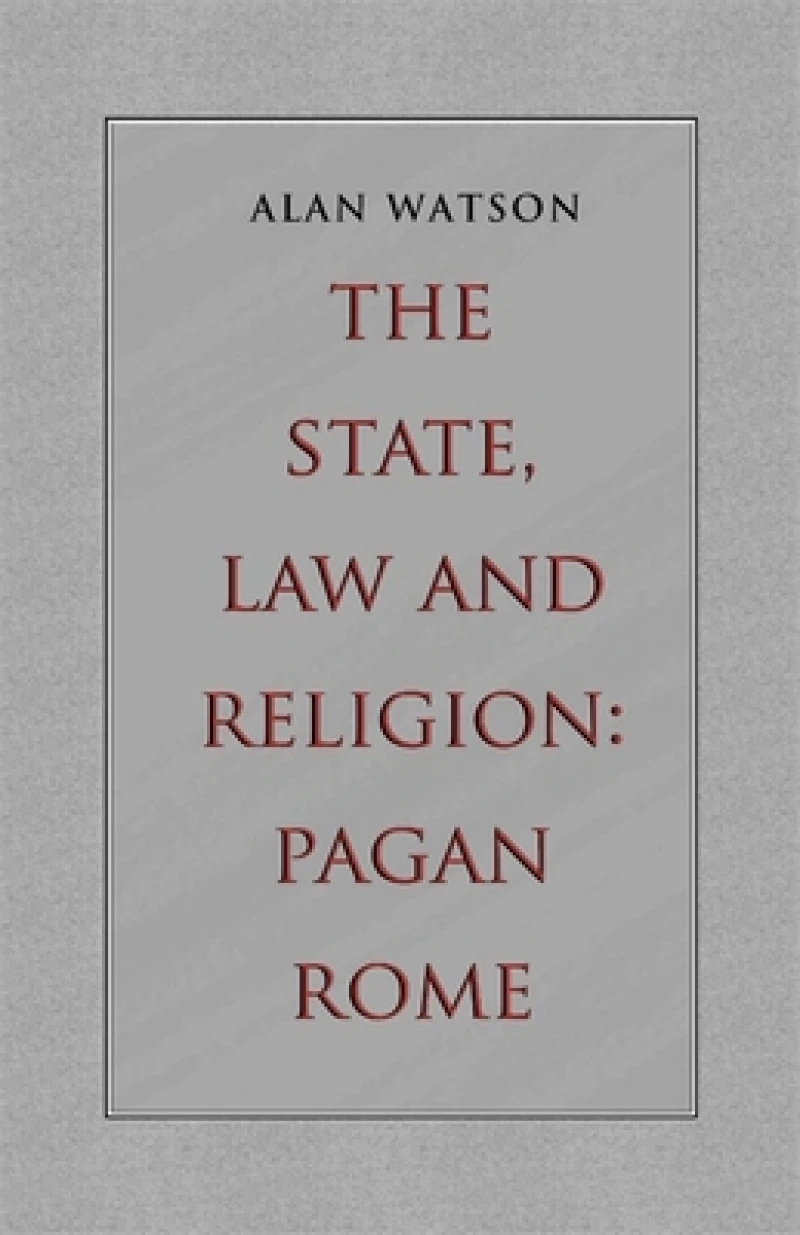
The State, Law and Religion – Pagan Rome : Pagan Rome
by
Alan Watson
Book Details
Format
Paperback / Softback
ISBN-10
0820341185
ISBN-13
9780820341187
Publisher
University of Georgia Press
Imprint
University of Georgia Press
Country of Manufacture
US
Country of Publication
GB
Publication Date
Sep 1st, 2012
Print length
152 Pages
Weight
249 grams
Dimensions
22.90 x 15.20 x 0.90 cms
Product Classification:
Ancient history: to c 500 CELegal historyAncient history
Ksh 4,500.00
Werezi Extended Catalogue
0 in stock
Delivery Location
Delivery fee: Select location
Secure
Quality
Fast
A major new perspective on the nature and development of Roman law in the early republic and empire before Christianity was recognized by Constantine. Watson analyses how modes of legal reasoning in sacred law were carried over to private law, where they were often less appropriate, and were passed on to modern legal systems.
Written by one of our most respected legal historians, this book analyzes the interaction of law and religion in ancient Rome. As such, it offers a major new perspective on the nature and development of Roman law in the early republic and empire before Christianity was recognized and encouraged by Constantine. At the heart of the book is the apparent paradox that Roman private law is remarkably secular even though, until the late second century B.C., the Romans were regarded (and regarded themselves) as the most religious people in the world. Adding to the paradox was the fact that the interpretation of private law, which dealt with relations between private citizens, lay in the hands of the College of Pontiffs, an advisory body of priests. Alan Watson traces the roots of the paradox—and the way in which Roman law ultimately developed—to the conflict between patricians and plebeians that occurred in the mid-fifth century B.C. When the plebeians demanded equality of all citizens before the law, the patricians prepared in response the Twelve Tables, a law code that included only matters considered appropriate for plebeians. Public law, which dealt with public officials and the governance of the state, was totally excluded form the code, thus preserving gross inequalities between the classes of Roman citizens. Religious law, deemed to be the preserve of patrician priests, was also excluded. As Watson notes, giving a monopoly of legal interpretation to the College of Pontiffs was a shrewd move to maintain patrician advantages; however, a fundamental consequence was that modes of legal reasoning appropriate for judgments in sacred law were carried over to private law, where they were often less appropriate. Such reasoning, Watson contends, persists even in modern legal systems. After sketching the tenets of Roman religion and the content of the Twelve Tables, Watson proceeds to such matters as formalism in religion and law, religion and property, and state religion versus alien religion. In his concluding chapter, he compares the law that emerged after the adoption of the Twelve Tables with the law that reportedly existed under the early Roman kings.
Get The State, Law and Religion – Pagan Rome by at the best price and quality guaranteed only at Werezi Africa's largest book ecommerce store. The book was published by University of Georgia Press and it has pages.

