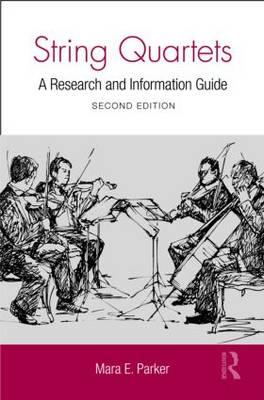
The String Quartet 1750-1797 : Four Types of Musical Conversation
by
Mara Parker
Book Details
Format
Paperback / softback
ISBN-10
1138384089
ISBN-13
9781138384088
Publisher
Taylor & Francis Ltd
Imprint
Routledge
Country of Manufacture
GB
Country of Publication
GB
Publication Date
Sep 18th, 2018
Print length
336 Pages
Weight
508 grams
Dimensions
15.40 x 23.30 x 3.80 cms
KSh 10,600.00
Currently unavailable
0 in stock
Delivery Location
Delivery fee: Select location
Secure
Quality
Fast
The second half of the eighteenth century witnessed a flourishing of the string quartet, often represented as a smooth and logical progression from first violin-dominated homophony to a more equal conversation between the four voices. Yet this progression was neither as smooth nor as linear as previously thought, as Mara Parker illustrates in her examination of the string quartet during this period. Looking at a wide variety of string quartets by composers such as Pleyel, Distler and Filtz, in addition to Haydn and Mozart, the book proposes a new way of describing the relationships between the four instruments in different works. Broadly speaking, these relationships follow one of four patterns: the ''lecture'', the ''polite conversation'', the ''debate'', and the ''conversation''. In focusing on these musical discourses, it becomes apparent that each work is the product of its composer''s stylistic choices, location, intended performers and intended audience. Instead of evolving in a strict and universal sequence, the string quartet in the latter half of the eighteenth century was a complex genre with composers mixing and matching musical discourses as circumstances and their own creative impulses required.
Get The String Quartet 1750-1797 by Mara Parker at the best price and quality guaranteed only at Werezi Africa's largest book ecommerce store. The book was published by Taylor & Francis Ltd and it has 336 pages.
Customers Who Bought This Also Bought
Music Against Night
KSh 2,700.00

Structural Functions of Harmony
KSh 2,700.00

The Technique of Orchestration
KSh 14,250.00
The Shortest History of Music
KSh 2,700.00
Wagnerism
KSh 5,400.00

Complete Classical Music Guide
KSh 4,600.00
Sonatas and Partitas for Violin Solo BWV 1001-1006 (Transcribed for Viola)
KSh 3,400.00

Sonatas and Partitas for Violin Solo BWV 1001-1006
KSh 3,100.00
The Cambridge History of Western Music Theory
KSh 12,200.00
Sonatas and Partitas for Violin Solo BWV 1001-1006
KSh 3,600.00
The Lobkowicz Collections Music Series
KSh 1,800.00

A Very Unusual Way
KSh 4,200.00