
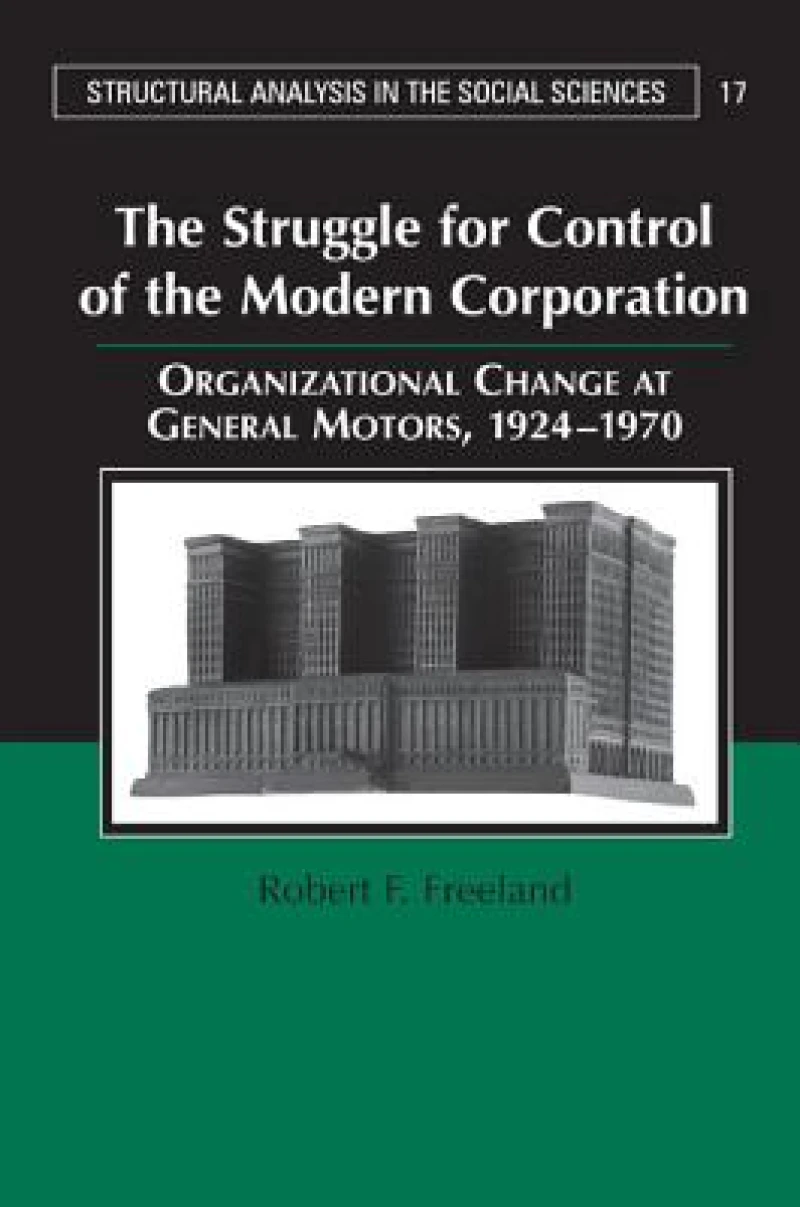
The Struggle for Control of the Modern Corporation : Organizational Change at General Motors, 1924–1970
Book Details
Format
Paperback / Softback
Book Series
Structural Analysis in the Social Sciences
ISBN-10
0521677912
ISBN-13
9780521677912
Publisher
Cambridge University Press
Imprint
Cambridge University Press
Country of Manufacture
GB
Country of Publication
GB
Publication Date
Dec 26th, 2005
Print length
384 Pages
Weight
51 grams
Dimensions
22.90 x 15.20 x 2.20 cms
Product Classification:
United States of America, USAc 1919 to c 1939 (Inter-war period)c 1938 to c 1946 (World War Two period)c 1950 to c 1959Industrialisation & industrial historyRoad vehicle manufacturing industryVehicle and transport manufacturing industriesIndustrialisation and industrial history
Ksh 7,750.00
Manufactured on Demand
0 in stock
Delivery Location
Delivery fee: Select location
Secure
Quality
Fast
Drawing on primary historical material, The Struggle for Control of the Modern Corporation, provides a historical overview of decision making and political struggle within one of America's largest and most important corporations, General Motors. The book illustrates how GM intentionally violated the fundamental axioms of efficient organization put forth by analysts.
Winner of the 2005 Business History Review Newcomen Award for best book in business history, The Struggle for Control of the Modern Corporation provides a fascinating historical overview of decision-making and political struggle within one of America's largest and most important corporations. Drawing on primary historical material, Robert Freeland examines the changes in General Motors' organization between the years 1924 and 1970. He takes issue with the well-known argument of business historian Alfred Chandler and economist Oliver Wiliamson, who contend that GM's multidivisional corporate structure emerged and survived because it was more efficient than alternative forms of organization. This book illustrates that for most of its history, GM intentionally violated the fundamental axioms of efficient organization put forth by these analysts. It did so in order to create cooperation and managerial consent to corporate policies. Freeland uses the GM case to re-examine existing theories of corporate governance, arguing that the decentralized organizational structure advocated by efficiency theorists may actually undermine cooperation, and thus foster organizational decline.
Get The Struggle for Control of the Modern Corporation by at the best price and quality guaranteed only at Werezi Africa's largest book ecommerce store. The book was published by Cambridge University Press and it has pages.

