
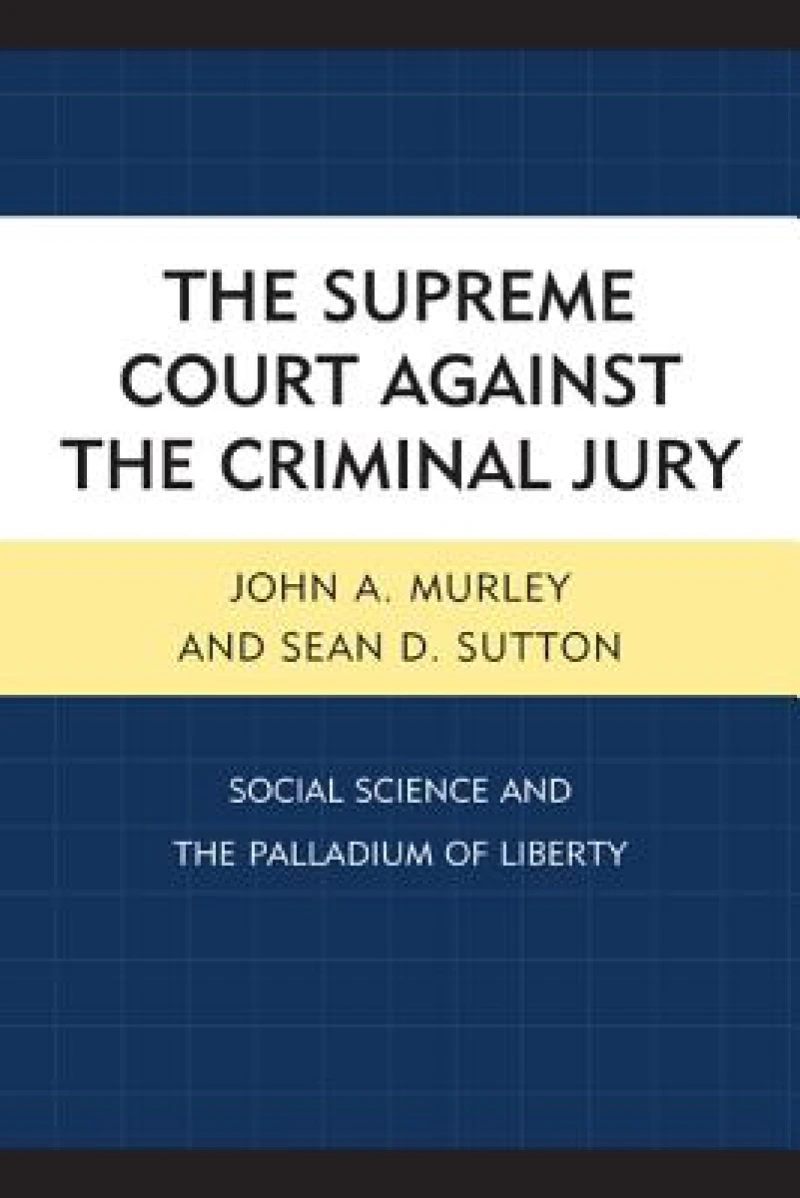
The Supreme Court against the Criminal Jury : Social Science and the Palladium of Liberty
Book Details
Format
Paperback / Softback
ISBN-10
0739136224
ISBN-13
9780739136225
Publisher
Bloomsbury Publishing Plc
Imprint
Lexington Books
Country of Manufacture
GB
Country of Publication
GB
Publication Date
Jun 12th, 2014
Print length
140 Pages
Weight
204 grams
Dimensions
22.70 x 15.50 x 1.00 cms
Product Classification:
Constitution: government & the stateLegal historyCourts & procedure
Ksh 9,600.00
Manufactured on Demand
0 in stock
Delivery Location
Delivery fee: Select location
Secure
Quality
Fast
The Supreme Court against the Criminal Jury: Social Science and the Palladium of Liberty is an analysis of the United States Supreme Court decisions in what has come to be called the “jury-size” and “jury-decision rule” cases. In Williams v. Florida (1970) and Ballew v. Georgia (1978), a majority of the Supreme Court looked to history, empirical studies, and functional analysis to support its claim that there was “no discernible difference” between the verdicts of juries of six and juries of twelve. In the process the Court also decided that the number twelve was an historical accident and that the twelve-member jury was not an essential ingredient of trial by jury. Two years later, the Court, following essentially the same line of reasoning used in Williams, decided in the companion cases Apodaca v. Oregon (1972) and Johnson v. Louisiana (1972) that defendants were as well served with juries that reached verdicts by a majority vote of 11-1,10-2 and 9-3 as they were with unanimous jury verdicts. In these cases the Supreme Court rejected the centuries old common law view that the unanimous jury verdict was an essential element of trial by jury. With these four decisions, the criminal jury as it had been known for more than six hundred years under the common law and the Constitution was in principle abandoned. We critique these decisions from the perspective of unreliable jury studies and the impact of these decision on jury nullification.
The Supreme Court against the Criminal Jury: Social Science and the Palladium of Liberty is an analysis of the United States Supreme Court decisions in what has come to be called the “jury-size” and “jury-decision rule” cases. In Williams v. Florida (1970) and Ballew v. Georgia (1978), a majority of the Supreme Court looked to history, empirical studies, and functional analysis to support its claim that there was “no discernible difference” between the verdicts of juries of six and juries of twelve. In the process the Court also decided that the number twelve was an historical accident and that the twelve-member jury was not an essential ingredient of trial by jury. Two years later, the Court, following essentially the same line of reasoning used in Williams, decided in the companion cases Apodaca v. Oregon (1972) and Johnson v. Louisiana (1972) that defendants were as well served with juries that reached verdicts by a majority vote of 11-1,10-2 and 9-3 as they were with unanimous jury verdicts. In these cases the Supreme Court rejected the centuries old common law view that the unanimous jury verdict was an essential element of trial by jury. With these four decisions, the criminal jury as it had been known for more than six hundred years under the common law and the Constitution was in principle abandoned. We critique these decisions from the perspective of unreliable jury studies and the impact of these decision on jury nullification.
Get The Supreme Court against the Criminal Jury by at the best price and quality guaranteed only at Werezi Africa's largest book ecommerce store. The book was published by Bloomsbury Publishing Plc and it has pages.

