
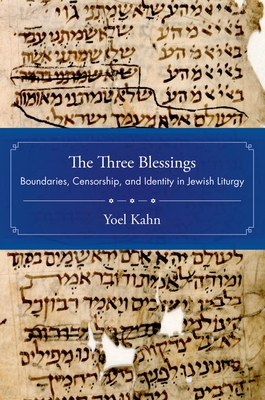
The Three Blessings : Boundaries, Censorship, and Identity in Jewish Liturgy
by
Yoel Kahn
Book Details
Format
Hardback
ISBN-10
0195373294
ISBN-13
9780195373295
Publisher
Oxford University Press Inc
Imprint
Oxford University Press Inc
Country of Manufacture
US
Country of Publication
GB
Publication Date
Jan 20th, 2011
Print length
240 Pages
Weight
454 grams
Dimensions
16.30 x 23.90 x 2.30 cms
KSh 14,300.00
Temporarily out of stock, due soon
0 in stock
Delivery Location
Delivery fee: Select location
Secure
Quality
Fast
In the traditional Jewish liturgy, a man praises God daily for not having been made a gentile, a woman, or a slave. Manuscript editions of the Babylonian Talmud teach that recitation of this prayer is obligatory for all Jewish men. Despite the fact that these blessings have been officially part of the daily morning liturgy for more than a thousand years, the propriety of whether and how to recite them is an ongoing subject of debate. Yoel Kahn offers the first longitudinal study of the evolving language, usage, and interpretation of a Jewish liturgical text over its entire 2000 year life-span.
According to historical teaching, a Jewish man should give thanks each day for ''''not having been made a gentile, a woman, nor a slave.'''' Yoel Kahn''s innovative study of a controversial Jewish liturgical passage traces the history of this prayer from its extra-Jewish origins across two thousand years of history, demonstrating how different generations and communities understood the significance of these words in light of their own circumstances. Marking the boundary between ''''us'''' and ''''them,'''' marginalized and persecuted groups affirmed their own identity and sense of purpose. After the medieval Church seized and burned books it considered offensive, new, coded formulations emerged as forms of spiritual resistance. Owners voluntarily carefully expurgated their books to save them from being destroyed, creating new language and meanings while seeking to preserve the structure and message of the received tradition. Renaissance Jewish women ignored rabbis'' objections and assertively declared their gratitude at being ''''made a woman and not a man.'''' Illustrations from medieval and renaissance Hebrew manuscripts demonstrate creative literary responses to censorship and show that official texts and interpretations do not fully represent the historical record. As Jewish emancipation began in the 19th century, modernizing Jews again had to balance fealty to historical practice with their own and others'' understanding of their place in the world. Seeking to be recognized as modern and European, early modern Jews rewrote the liturgy to fit modern sensibilities and identified themselves with the Christian West against the historical pagan and the uncivilized infidel. In recent decades, a reassertion of ethnic and cultural identity has again raised questions of how the Jewish religious community should define itself. Through the lens of a liturgical text in continuous use for over two thousand years, Kahn offers new insights into an evolving religious identity and recurring questions of how to honor both historical teaching and contemporary sensibility.
Get The Three Blessings by Yoel Kahn at the best price and quality guaranteed only at Werezi Africa's largest book ecommerce store. The book was published by Oxford University Press Inc and it has 240 pages.
Customers Who Bought This Also Bought

Education in Religious Contexts of Late Antiquity
KSh 3,250.00
Poetry of Prayer
KSh 5,050.00

Prayer Rites of Synagogal Worship and their Historical Development
KSh 3,900.00
Rose Guide to the Feasts, Festivals and Fasts of the Bible
KSh 6,850.00

Religion in the Age of Digitalization
KSh 8,750.00
Ancient Jewish Prayers and Emotions
KSh 27,350.00
Etrog
KSh 10,800.00

Essence of Kabbalah
KSh 1,800.00
Early Jewish Prayers in Greek
KSh 31,750.00
Siddur Hatefillah
KSh 4,800.00
Jews and Protestants
KSh 14,400.00
The Sabbath
KSh 3,050.00
More in This Genre
Education in Religious Contexts of Late Antiquity
KSh 3,250.00
Poetry of Prayer
KSh 5,050.00
Prayer Rites of Synagogal Worship and their Historical Development
KSh 3,900.00
Rose Guide to the Feasts, Festivals and Fasts of the Bible
KSh 6,850.00
Religion in the Age of Digitalization
KSh 8,750.00
Ancient Jewish Prayers and Emotions
KSh 27,350.00
