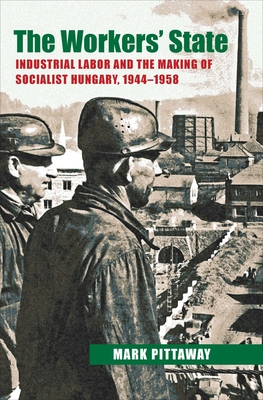
The Workers' State : Industrial Labor and the Making of Socialist Hungary, 1944–1958
Book Details
Format
Hardback
Book Series
Russian and East European Studies
ISBN-10
0822944200
ISBN-13
9780822944201
Publisher
University of Pittsburgh Press
Imprint
University of Pittsburgh Press
Country of Manufacture
US
Country of Publication
GB
Publication Date
Oct 28th, 2012
Print length
400 Pages
Weight
712 grams
Dimensions
17.90 x 24.60 x 3.00 cms
Product Classification:
European historyEuropean history
KSh 10,700.00
Temporarily out of stock, due soon
0 in stock
Delivery Location
Delivery fee: Select location
Secure
Quality
Fast
A groundbreaking study of the complexities of the Hungarian working class, its relationship to the Communist Party, and its major political role during the foundational period of socialism (1944-1958). Named an Outstanding Academic Title for 2013 by Choice Magazine
In 1956, Hungarian workers joined students on the streets to protest years of wage and benefit cuts enacted by the Communist regime. Although quickly suppressed by Soviet forces, the uprising led to changes in party leadership and conciliatory measures that would influence labor politics for the next thirty years. In The Workers' State, Mark Pittaway presents a groundbreaking study of the complexities of the Hungarian working class, its relationship to the Communist Party, and its major political role during the foundational period of socialism (1944-1958). Through case studies of three industrial centers—Ujpest, Tatabanya, and Zala County—Pittaway analyzes the dynamics of gender, class, generation, skill level, and rural versus urban location, to reveal the embedded hierarchies within Hungarian labor. He further demonstrates how industries themselves, from oil and mining to armaments and textiles, possessed their own unique labor subcultures. From the outset, the socialist state won favor with many workers, as they had grown weary of the disparity and oppression of class systems under fascism. By the early 1950s, however, a gap between the aspirations of labor and the goals of the state began to widen. In the Stalinist drive toward industrialization, stepped up production measures, shortages of goods and housing, wage and benefit cuts, and suppression became widespread. Many histories of this period have focused on Communist terror tactics and the brutal suppression of a pliant population. In contrast, Pittaway's social chronicle sheds new light on working-class structures and the determination of labor to pursue its own interests and affect change in the face of oppression. It also offers new understandings of the role of labor and the importance of local histories in Eastern Europe under communism.
Get The Workers' State by Mark Pittaway at the best price and quality guaranteed only at Werezi Africa's largest book ecommerce store. The book was published by University of Pittsburgh Press and it has 400 pages.
Customers Who Bought This Also Bought

Age of Revolutions
KSh 2,350.00

Eichmann in Jerusalem
KSh 2,350.00

Trouble With Being Born
KSh 2,000.00

Hiroshima
KSh 2,000.00

Freedom
KSh 6,300.00

Holocaust
KSh 2,700.00
The History of the Peloponnesian War
KSh 2,700.00

Annals
KSh 2,350.00

Greek Lives
KSh 2,150.00

Sleepwalkers
KSh 3,400.00

Napoleon The Great
KSh 3,600.00

Diary of a Young Girl
KSh 1,800.00