
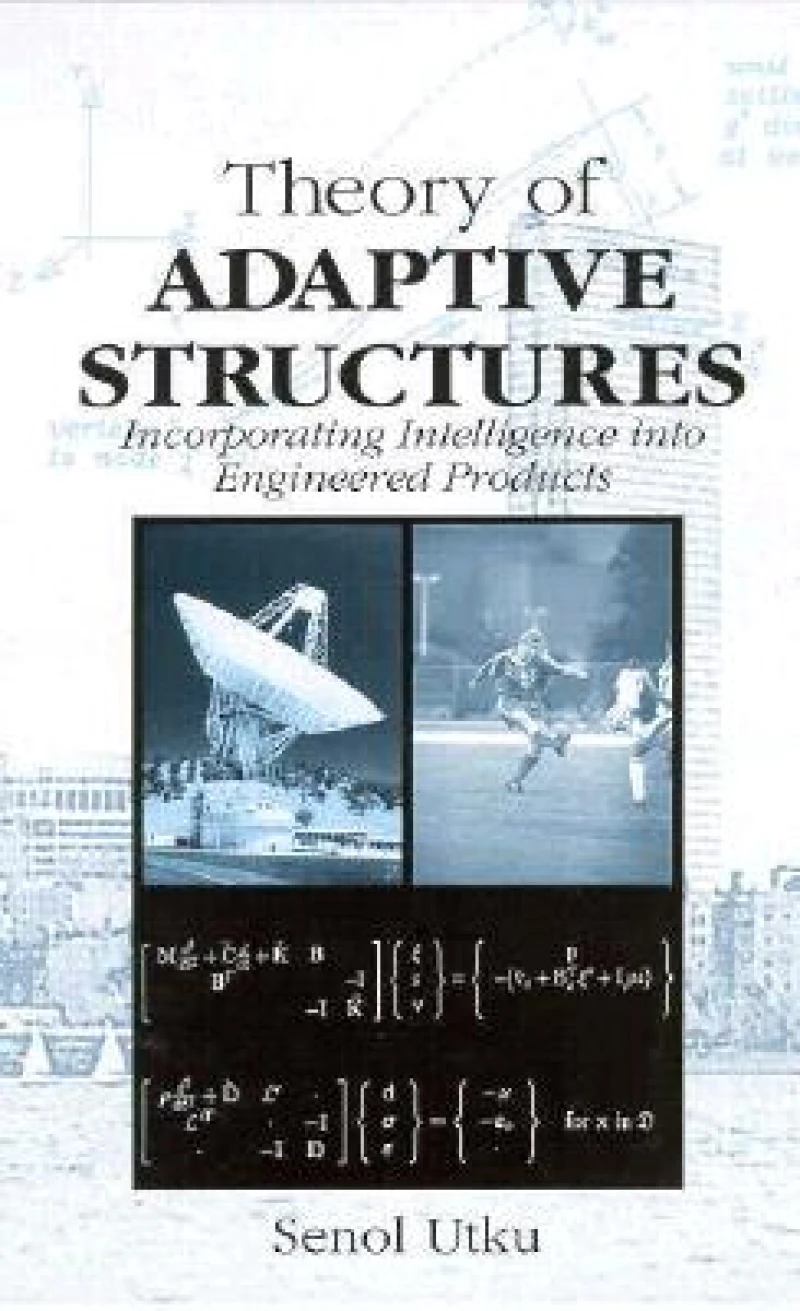
Theory of Adaptive Structures : Incorporating Intelligence into Engineered Products
by
Senol Utku
Book Details
Format
Hardback or Cased Book
Book Series
New Directions in Civil Engineering
ISBN-10
0849374316
ISBN-13
9780849374319
Publisher
Taylor & Francis Inc
Imprint
CRC Press Inc
Country of Manufacture
GB
Country of Publication
GB
Publication Date
Feb 18th, 1998
Print length
294 Pages
Weight
595 grams
Product Classification:
Structural engineering
Ksh 9,350.00
Werezi Extended Catalogue
Delivery in 28 days
Delivery Location
Delivery fee: Select location
Delivery in 28 days
Secure
Quality
Fast
Theory of Adaptive Structures furnishes the basic theory needed for actively controlling the behavior of engineering systems. The text examines the advance of materials technology and the advent of powerful, reliable microprocessors.
Theory of Adaptive Structures provides the basic theory for controlling adaptive structures in static and dynamic environments. It synthesizes well-established theories on modern control as well as statics and dynamics of deformable bodies. Discussions concentrate on the discrete parameter adaptive structures dealing with actuator placement, actuator selection, and actuation computation problems - keeping these structures at close proximity of any chosen nominal state with the least energy consumption. An introduction to the distributed parameter adaptive structures is also provided.
The book follows that modern trend in research and industry striving to incorporate intelligence into engineered products through microprocessors that are becoming smaller, faster, and cheaper at astounding rates. Not using them in engineered products may become an enormous liability.
Resulting from the advances in materials technology on sensors and actuator technologies as well as the availability of very powerful and reliable microprocessors, there is an ever-increasing interest in actively controlling the behavior of engineering systems. Engineers and engineering scientists must revive and broaden their activities to maximize applications for predicting and controlling the behavior of deformable bodies.
Topics include:
An introduction to adaptive structures
Incremental excitation-response relations in static and dynamic cases
Active control of response in static case
Statically determinate adaptive structures
Statically indeterminate adaptive structures
Active vibration control for autonomous and non-autonomous cases
Active control against wind
Active control against seismic loads
Distributed parameter adaptive structures
The technology of adaptive structures has created an environment where the analysis, not the computation, of structural response - du
The book follows that modern trend in research and industry striving to incorporate intelligence into engineered products through microprocessors that are becoming smaller, faster, and cheaper at astounding rates. Not using them in engineered products may become an enormous liability.
Resulting from the advances in materials technology on sensors and actuator technologies as well as the availability of very powerful and reliable microprocessors, there is an ever-increasing interest in actively controlling the behavior of engineering systems. Engineers and engineering scientists must revive and broaden their activities to maximize applications for predicting and controlling the behavior of deformable bodies.
Topics include:
The technology of adaptive structures has created an environment where the analysis, not the computation, of structural response - du
Get Theory of Adaptive Structures by at the best price and quality guaranteed only at Werezi Africa's largest book ecommerce store. The book was published by Taylor & Francis Inc and it has pages.

