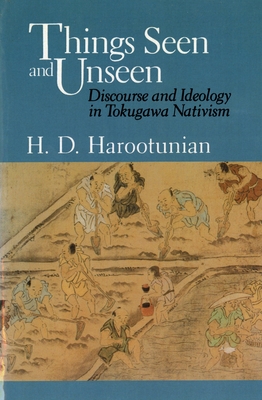
Things Seen and Unseen : Discourse and Ideology in Tokugawa Nativism
Book Details
Format
Paperback / softback
ISBN-10
0226317072
ISBN-13
9780226317076
Publisher
The University of Chicago Press
Imprint
University of Chicago Press
Country of Manufacture
US
Country of Publication
GB
Publication Date
Mar 15th, 1988
Print length
508 Pages
Weight
714 grams
Dimensions
15.30 x 23.00 x 2.80 cms
Product Classification:
Indigenous peoplesAnthropology
KSh 8,500.00
Currently unavailable
0 in stock
Delivery Location
Delivery fee: Select location
Secure
Quality
Fast
This long-awaited work explores the place of kokugaku (rendered here as "nativism") during Japan's Tokugawa period. Kokugaku, the sense of a distinct and sacred Japanese identity, appeared in the eighteenth century in reaction to the pervasive influence of Chinese culture on Japan. Against this influence, nativists sought a Japanese sense of difference grounded in folk tradition, agricultural values, and ancient Japanese religion. H. D. Harootunian treats nativism as a discourse and shows how it functioned ideologically in Tokugawa Japan.
Get Things Seen and Unseen by Harry D. Harootunian at the best price and quality guaranteed only at Werezi Africa's largest book ecommerce store. The book was published by The University of Chicago Press and it has 508 pages.
Customers Who Bought This Also Bought

Democracy of Species
KSh 1,450.00

Men of Maize
KSh 3,050.00
Women Of Maize
KSh 3,850.00

Ghost Nation
KSh 3,950.00

Thicker Than Water
KSh 2,000.00

Boudicca''s Daughter
KSh 2,750.00

Boudicca''s Daughter
KSh 3,400.00

Do The Work
KSh 2,500.00

Rainforest Warriors
KSh 4,300.00
Mayalogue
KSh 4,600.00

They Had Names
KSh 3,900.00
![Early Chapters of Seneca History [microform]](https://book-images.us-southeast-1.linodeobjects.com/images/9781015382565.jpg)
Early Chapters of Seneca History [microform]
KSh 4,300.00