
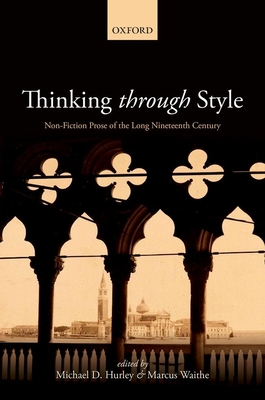
Thinking Through Style : Non-Fiction Prose of the Long Nineteenth Century
Book Details
Format
Hardback
ISBN-10
0198737823
ISBN-13
9780198737827
Publisher
Oxford University Press
Imprint
Oxford University Press
Country of Manufacture
GB
Country of Publication
GB
Publication Date
Jan 11th, 2018
Print length
374 Pages
Weight
694 grams
Dimensions
16.70 x 24.20 x 3.00 cms
KSh 20,150.00
Temporarily out of stock, due soon
0 in stock
Delivery Location
Delivery fee: Select location
Secure
Quality
Fast
This ambitious and timely book reconceives style as having the capacity to clarify or generate thinking, rather than merely being something linguistic or ornamental. The volume surveys non-fiction prose of twenty authors of the nineteenth-century to reimagine the interplay between thinking, thinkers, style, and stylists.
What is ''style'', and how does it relate to thought in language? It has often been treated as something merely linguistic, independent of thought, ornamental; stylishness for its own sake. Or else it has been said to subserve thought, by mimicking, delineating, or heightening ideas that are already expressed in the words. This ambitious and timely book explores a third, more radical possibility in which style operates as a verbal mode of thinking through. Rather than figure thought as primary and pre-verbal, and language as a secondary delivery system, style is conceived here as having the capacity to clarify or generate thinking. The book''s generic focus is on non-fiction prose, and it looks across the long nineteenth century. Leading scholars survey twenty authors to show where writers who have gained reputations as either ''stylists'' or as ''thinkers'' exploit the interplay between ''the what'' and ''the how'' of their prose. The study demonstrates how celebrated stylists might, after all, have thoughts worth attending to, and that distinguished thinkers might be enriched for us if we paid more due to their style. More than reversing the conventional categories, this innovative volume shows how ''style'' and ''thinking'' can be approached as a shared concern. At a moment when, especially in nineteenth-century studies, interest in style is re-emerging, this book revaluates some of the most influential figures of that age, re-imagining the possible alliances, interplays, and generative tensions between thinking, thinkers, style, and stylists.
Get Thinking Through Style by Marcus Waithe at the best price and quality guaranteed only at Werezi Africa's largest book ecommerce store. The book was published by Oxford University Press and it has 374 pages.
Customers Who Bought This Also Bought

How to Read & Why
KSh 2,350.00
Stranger Faces
KSh 2,500.00
Classical Literary Criticism
KSh 2,350.00
Recognising the Stranger
KSh 1,800.00
What is Literature?
KSh 3,250.00

Beginnings
KSh 3,050.00

Create Dangerously
KSh 700.00

An Analysis of Immanuel Kant''s Critique of Pure Reason
KSh 1,200.00
Chaucer's Pardoner and Gender Theory
KSh 8,100.00
Black and Female
KSh 2,350.00

Difference and Repetition
KSh 4,500.00
The Social Construction of What?
KSh 5,200.00
