
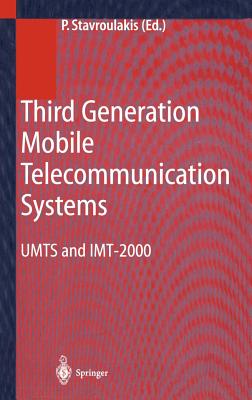
Third Generation Mobile Telecommunication Systems : UMTS and IMT-2000
2001 ed.
Book Details
Format
Hardback
ISBN-10
3540678506
ISBN-13
9783540678502
Edition
2001 ed.
Publisher
Springer-Verlag Berlin and Heidelberg GmbH & Co. KG
Imprint
Springer-Verlag Berlin and Heidelberg GmbH & Co. K
Country of Manufacture
GB
Country of Publication
GB
Publication Date
Mar 12th, 2001
Print length
657 Pages
Product Classification:
Electrical engineeringElectronics engineeringRadio technology
KSh 23,400.00
Currently unavailable
0 in stock
Delivery Location
Delivery fee: Select location
Secure
Quality
Fast
The first generation cellular era started with the Analog Systems and evolved in the digital domain utilizing Time Division Multiple Access (TDMA) and Code Division Multiple Access (CDMA), thus comprising the Second Generation Mobile Systems.
One hundred years ago, the notion of transmitting information without the use of wires must have seemed like magic. In 1896, the first patent for wireless communication was granted to Marchese Guglielmo Marconi. Since then the field of wireless communications which includes cellular systems has taken various forms of development. It basically evolved through three Eras. The Pioneer Era over the period of 1860-1921, the Precellular Era over 1921-1980 and the Cellular Era after 1980 and beyond. The first generation cellular era started with the Analog Systems and evolved in the digital domain utilizing Time Division Multiple Access (TDMA) and Code Division Multiple Access (CDMA), thus comprising the Second Generation Mobile Systems. The first generation RF cellular communications systems deployed in the early to mid 1980''s had air interfaces comprised of analog technology. Among them were AMPS (Advanced Mobile Phone System), NMT (Nordic Mobile Telephone), and TACS (Total Access Communications System). These were designed for use in a specific geographic area and not intended to be deployed in other areas. There was not much commonality beyond using the same air interface technology and same modulation. The air interface technology was Frequency Division Multiple Access (FDMA) and the modulation was analog FM, but with different deviations and channel spacings. The frequency bands, air interface protocols, number of channels, and data rates were different. In general, these systems provided local and national coverage.
Get Third Generation Mobile Telecommunication Systems by Peter Stavroulakis at the best price and quality guaranteed only at Werezi Africa's largest book ecommerce store. The book was published by Springer-Verlag Berlin and Heidelberg GmbH & Co. KG and it has 657 pages.
Customers Who Bought This Also Bought
White Noise Distribution Theory
KSh 9,750.00

Construction Mathematics
KSh 7,500.00
Lectures On White Noise Functionals
KSh 21,600.00
Construction Mathematics
KSh 26,300.00
Ultra-Wideband Positioning Systems
KSh 12,050.00

Integrating Edge Intelligence and Blockchain
KSh 8,100.00

Intelligent Systems
KSh 30,950.00

AI in Modern Ophthalmology
KSh 18,700.00

AI in Modern Ophthalmology
KSh 9,900.00

Green Hydrogen and Fuel Cells
KSh 27,000.00

Intelligent Manufacturing Systems and Industry 5.0
KSh 18,700.00

Aqueous Batteries for Energy Storage
KSh 35,800.00
