
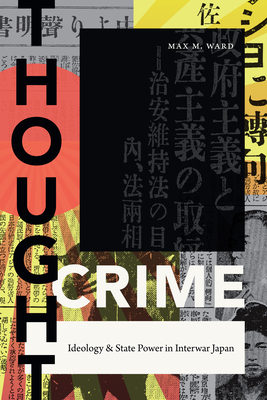
Thought Crime : Ideology and State Power in Interwar Japan
by
Max M. Ward
Book Details
Format
Hardback
Book Series
Asia-Pacific: Culture, Politics, and Society
ISBN-10
1478001313
ISBN-13
9781478001317
Publisher
Duke University Press
Imprint
Duke University Press
Country of Manufacture
US
Country of Publication
GB
Publication Date
Mar 15th, 2019
Print length
277 Pages
Weight
544 grams
Product Classification:
Asian history20th century history: c 1900 to c 2000Political ideologies
KSh 20,150.00
Currently unavailable
0 in stock
Delivery Location
Delivery fee: Select location
Secure
Quality
Fast
In Thought Crime Max M. Ward explores the Japanese state's efforts to suppress political radicalism in the 1920s and 1930s. Ward traces the evolution of an antiradical law called the Peace Preservation Law, from its initial application to suppress communism and anticolonial nationalism-what authorities deemed thought crime-to its expansion into an elaborate system to reform and ideologically convert thousands of thought criminals throughout the Japanese Empire. To enforce the law, the government enlisted a number of nonstate actors, who included monks, family members, and community leaders. Throughout, Ward illuminates the complex processes through which the law articulated imperial ideology and how this ideology was transformed and disseminated through the law's application over its twenty-year history. In so doing, he shows how the Peace Preservation Law provides a window into understanding how modern states develop ideological apparatuses to subject their respective populations.
Get Thought Crime by Max M. Ward at the best price and quality guaranteed only at Werezi Africa's largest book ecommerce store. The book was published by Duke University Press and it has 277 pages.
Customers Who Bought This Also Bought

From Third World to First
KSh 3,200.00

Breakneck
KSh 4,500.00

India After Gandhi
KSh 4,850.00

Anarchy
KSh 2,700.00

On China
KSh 3,400.00
Apostles of Development
KSh 5,600.00
Shattered Lands
KSh 2,000.00
Indira Gandhi and the Years that Transformed India
KSh 5,050.00
India: A Wounded Civilization
KSh 2,000.00
Shattered Lands
KSh 3,200.00
Games without Rules
KSh 2,900.00

Ghost Nation
KSh 3,950.00
