

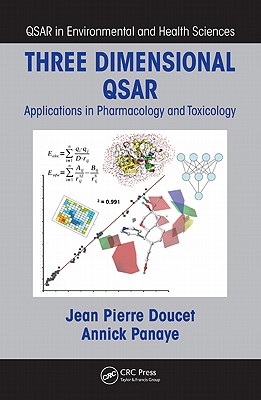
Three Dimensional QSAR : Applications in Pharmacology and Toxicology
Book Details
Delivery Location
Delivery fee: Select location
As a result of new statistical and mathematical approaches, improved visualization tools, and recognition by international regulatory groups, quantitative structure-activity relationships (QSARs) now play important roles in pharmacology for the design of new drugs as well as in toxicology and ecotoxicology for hazard identification and risk assessment. Providing up-to-date coverage of the field, Three Dimensional QSAR: Applications in Pharmacology and Toxicology presents the most recent QSAR methods and illustrates their scope, advantages, and limitations.
Part I
The first part of the book addresses CoMFA and related methods, such as CoMSIA, FLUFF, SOMFA. It also describes shape-, surface-, and volume-based approaches, including MSA, excluded volume, LIV, HASL, receptor surface model, COMPASS, and CoMSA.
Part II
Focusing on methods that use 3D information, the second part covers autocorrelation methods, such as GRIND; similarity-based methods, including similarity matrices and quantum similarity indices; and quantitative spectroscopic data?activity relationships. Some applications in data mining are also explored.
Part III
The third part deals with post-3D models. The authors discuss the adaptation of the receptor and simultaneous presence of several conformers or solvation mechanisms.
Part IV
The final part presents receptor-related approaches as well as docking and free energy calculations, which are treated at various levels. This part concerns the extensive sampling of phase space and approximate methods, such as linear interaction energy, Poisson?Boltzmann, and generalized Born models. A case study covering several parallel approaches is also developed.
An appendix offers the basic principles of modeling and statistical tools routinely required in QSAR methodologies, includi
Get Three Dimensional QSAR by Annick Panaye, Jean Pierre Doucet at the best price and quality guaranteed only at Werezi Africa's largest book ecommerce store. The book was published by Taylor & Francis Ltd and it has 576 pages.
Customers Who Bought This Also Bought

How to Use 3d Printing Innovations and Digital Storage to Democratize Anatomy Education
KSh 23,400.00

Clinical Epidemiology
KSh 23,400.00

For Everyone Bible Study Guide: 1 Corinthians
KSh 1,250.00

Immortal Life of Henrietta Lacks
KSh 2,000.00

Computational Design of Chemicals for the Control of Mosquitoes and Their Diseases
KSh 9,700.00

Post-Concussion Syndrome
KSh 5,300.00
Research Methods for Public Health
KSh 8,300.00

The Tuskegee Syphilis Study
KSh 3,950.00

Nanocarriers
KSh 28,800.00
Nobel Prizes That Changed Medicine
KSh 7,200.00

Engineering Biomaterials for Regenerative Medicine
KSh 23,400.00

Ethnography in Nursing Research
KSh 26,450.00
More by Annick Panaye, Jean Pierre Doucet
More in This Genre
How to Use 3d Printing Innovations and Digital Storage to Democratize Anatomy Education
KSh 23,400.00
Clinical Epidemiology
KSh 23,400.00
For Everyone Bible Study Guide: 1 Corinthians
KSh 1,250.00
Immortal Life of Henrietta Lacks
KSh 2,000.00
Computational Design of Chemicals for the Control of Mosquitoes and Their Diseases
KSh 9,700.00
Post-Concussion Syndrome
KSh 5,300.00
