
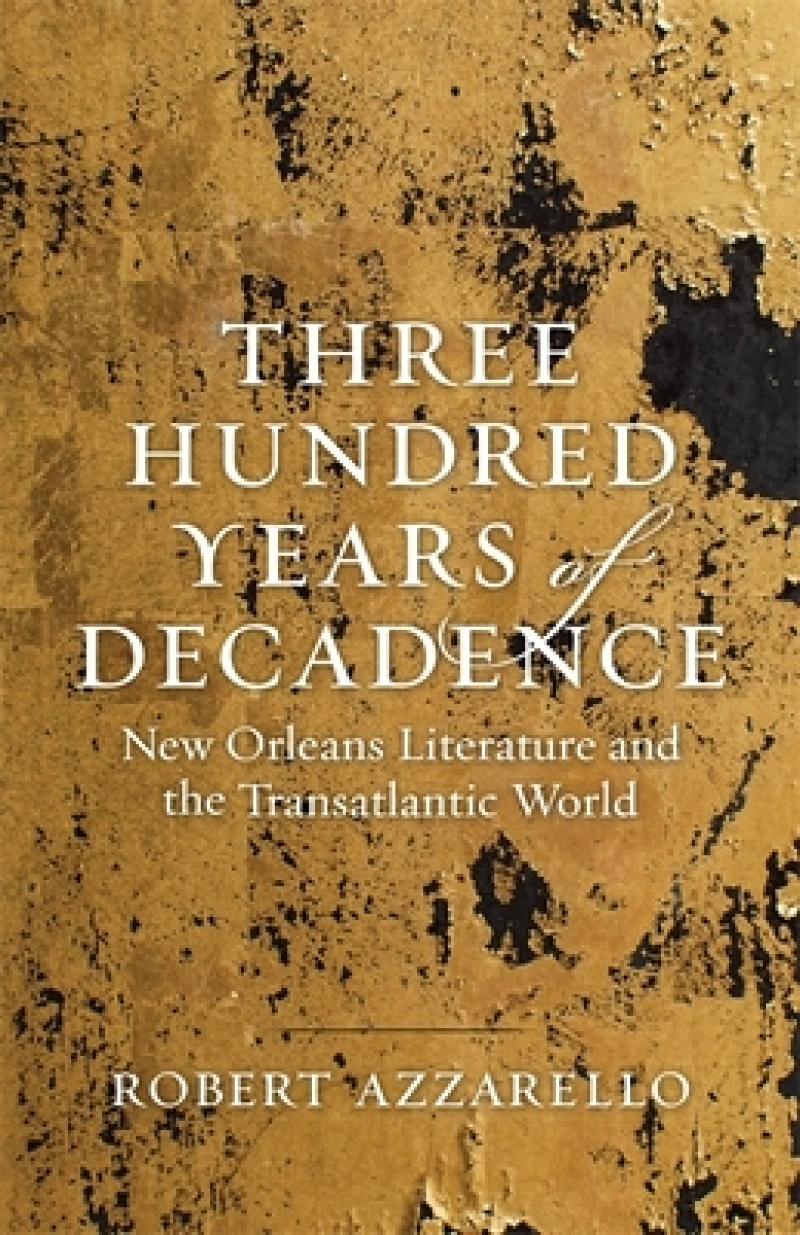
Three Hundred Years of Decadence : New Orleans Literature and the Transatlantic World
Book Details
Format
Hardback or Cased Book
ISBN-10
0807170453
ISBN-13
9780807170458
Publisher
Louisiana State University Press
Imprint
Louisiana State University Press
Country of Manufacture
US
Country of Publication
GB
Publication Date
Apr 9th, 2019
Print length
224 Pages
Weight
408 grams
Dimensions
21.60 x 14.00 x 2.20 cms
Product Classification:
Literature: history & criticismLiterature: history and criticism
Ksh 6,550.00
Temporarily out of stock, due soon
0 in stock
Delivery Location
Delivery fee: Select location
Secure
Quality
Fast
Argues that decadence can convey a more nuanced meaning than simple decay or decline conceived in physical, social, or moral terms. Instead, within New Orleans literature, decadence possesses a complex, even paradoxical relationship with beauty and health, progress, and technological advance.
New Orleans's reputation as a decadent city stems in part from its environmental precariousness, its Francophilia, its Afro-Caribbean connections, its Catholicism, and its litany of alleged ""vices,"" encompassing prostitution, miscegenation, homosexuality, and any number of the seven deadly sins. An evocative work of cultural criticism, Robert Azzarello's Three Hundred Years of Decadence argues that decadence can convey a more nuanced meaning than simple decay or decline conceived in physical, social, or moral terms. Instead, within New Orleans literature, decadence possesses a complex, even paradoxical relationship with concepts like beauty and health, progress, and technological advance.
Azzarello presents the concept of decadence, along with its perception and the uneasy social relations that result, as a suggestive avenue for decoding the long, shifting story of New Orleans and its position in the transatlantic world. By analyzing literary works that span from the late seventeenth century to contemporary speculations about the city's future, Azzarello uncovers how decadence often names a transfiguration of values, in which ideas about supposed good and bad cannot maintain their stability and end up morphing into one another. These evolving representations of a decadent New Orleans, which Azzarello traces with attention to both details of local history and insights from critical theory, reveal the extent to which the city functions as a contact zone for peoples and cultures from Europe, Africa, and the Americas.
Drawing on a deep and understudied archive of New Orleans literature, Azzarello considers texts from multiple genres (fiction, poetry, drama, song, and travel writing), including many written in languages other than English. His analysis includes such works of transcription and translation as George Washington Cable's ""Creole Slave Songs"" and Mary Haas's Tunica Texts, which he places in dialogue with canonical and recent works about the city, as well as with neglected texts like Ludwig von Reizenstein's German-language serial The Mysteries of New Orleans and Charles Chesnutt's novel Paul Marchand, F.M.C.
With its careful analysis and focused scope, Three Hundred Years of Decadence uncovers the immense significance- historically, politically, and aesthetically- that literary imaginings of a decadent New Orleans hold for understanding the city's position as a multicultural, transatlantic contact zone.
Azzarello presents the concept of decadence, along with its perception and the uneasy social relations that result, as a suggestive avenue for decoding the long, shifting story of New Orleans and its position in the transatlantic world. By analyzing literary works that span from the late seventeenth century to contemporary speculations about the city's future, Azzarello uncovers how decadence often names a transfiguration of values, in which ideas about supposed good and bad cannot maintain their stability and end up morphing into one another. These evolving representations of a decadent New Orleans, which Azzarello traces with attention to both details of local history and insights from critical theory, reveal the extent to which the city functions as a contact zone for peoples and cultures from Europe, Africa, and the Americas.
Drawing on a deep and understudied archive of New Orleans literature, Azzarello considers texts from multiple genres (fiction, poetry, drama, song, and travel writing), including many written in languages other than English. His analysis includes such works of transcription and translation as George Washington Cable's ""Creole Slave Songs"" and Mary Haas's Tunica Texts, which he places in dialogue with canonical and recent works about the city, as well as with neglected texts like Ludwig von Reizenstein's German-language serial The Mysteries of New Orleans and Charles Chesnutt's novel Paul Marchand, F.M.C.
With its careful analysis and focused scope, Three Hundred Years of Decadence uncovers the immense significance- historically, politically, and aesthetically- that literary imaginings of a decadent New Orleans hold for understanding the city's position as a multicultural, transatlantic contact zone.
Get Three Hundred Years of Decadence by at the best price and quality guaranteed only at Werezi Africa's largest book ecommerce store. The book was published by Louisiana State University Press and it has pages.

